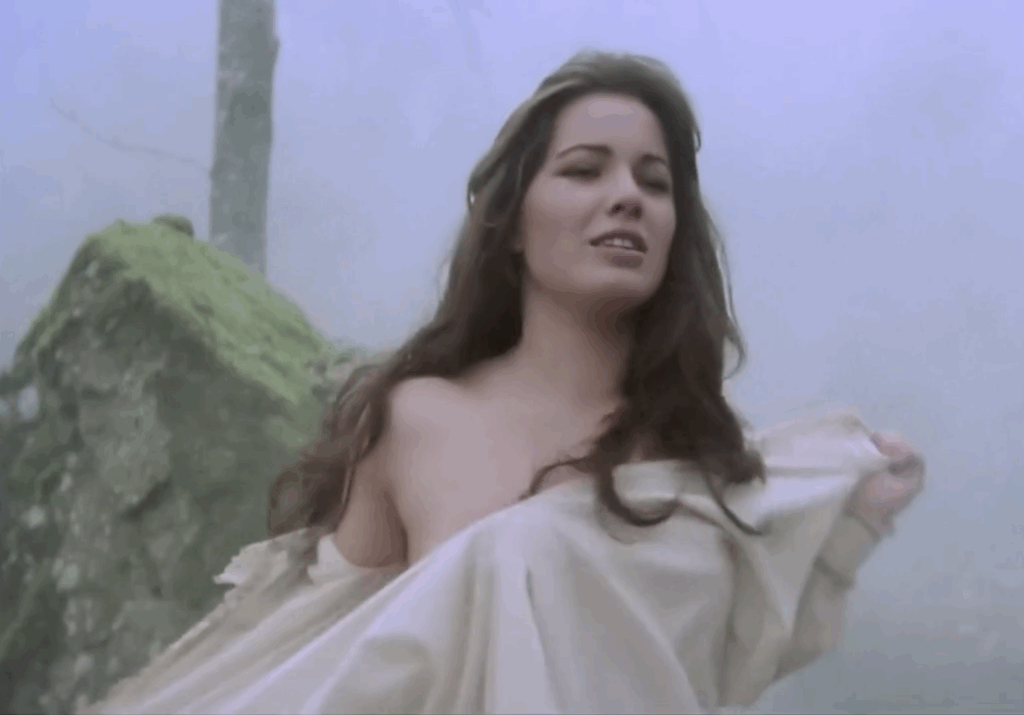
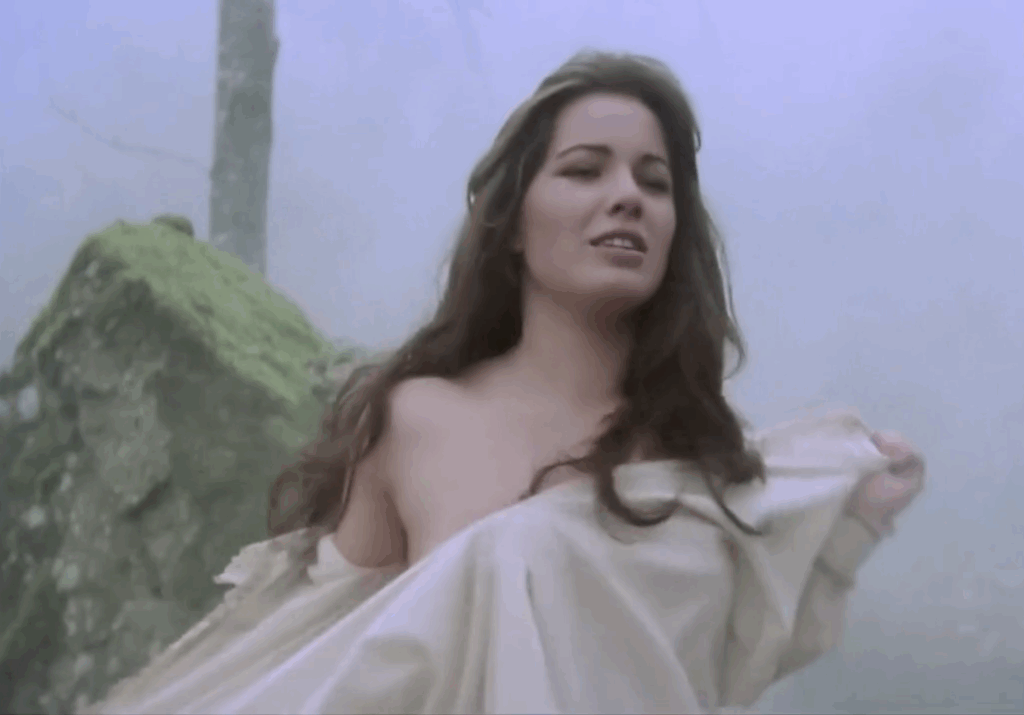
Mozarowsky in Beatriz (1976), directed by Gonzalo Suárez.
For centuries, philosophers, theologians, and poets have pursued the meaning of life. Is there one, and, if so, what is it? Spirituality? Religion? Ask a man on the street the meaning of life and he might just say “Surviving.”
But ask a teenager, and you’ll get your answer. She’ll tell you the meaning of life is Love, and her certainty should make you happy for her. By twelve, I’d fallen in love more than fifteen times. My romances were huge, earth-shattering, much more devastating and intense than any of the ones that came later. All the men were perfect, being imaginary, and since I saw no need for messy breakups, we always ended things on good terms.
When I was six or seven, our babysitter entertained us with fairy tales. She always told the same story. Once upon a time, in a faraway land, Pablo (my brother) married a princess and became king. Blanca (my sister) wed the crown prince of the country next door, which meant she, too, was in line for a throne. I always got the prince’s younger brother, which meant contenting myself with being a princess—and I was not content. Who would be? In my imagination, I stole my sister’s boyfriend.
Sandra Mozarowsky was never a queen. She was never a king’s girlfriend. She was the king’s lover, though, if you believe the rumors.
As the Franco regime approached its end, its subjects started demanding freedom of expression. Not the whole country, but enough of us to be heard. Our demands for liberty got louder and more insistent, and the regime took them to mean that we wanted to see breasts. We wanted naked women, or half-naked, and so we spent the mid-seventies gaping in awe as our country attained the dubious freedom of a national cinema starring girls who, without fail, opened or removed their tops within seconds of appearing onscreen.
Yes, in Spain, freedom was for breasts. You could spy some liberated bush in a semilegal softcore magazine, too, though never ever a penis. Visible male genitalia would be libertinism, which was anathema. According to the many government ministers and functionaries assigned to disseminate this message, liberty was one thing, libertinism another, and as a nation, it was important for us not to get them confused.
As a nation, we were waiting for Franco to die. Some of us were eager and excited; some were fretful and afraid. Some of us staged strikes and demonstrations that were met with ferocious police repression. In his sickbed, the dictator signed his last death sentences with a decisive, if shaky, hand. All the rest of us sat and watched destape.
Destape, which means “undressing,” was the name we gave our new erotica. We were such innocents, or such pigs, that we really did assume all those tits meant democracy and freedom, or, at the very least, an uplifting promise of both.
Sandra Mozarowsky was a destape actress, but before that, she was a girl. She was one her whole life, really: she died at eighteen. She was born in Tangiers in 1958 (three years before me), the third and youngest child of a Russian father, Boris, and Spanish mother, Charo Ruiz de Frías. In 1961 the family moved to Madrid, where Sandra studied at the British School and, according to a piece in the October 1, 1977, issue of ¡Hola!, “began to demonstrate her artistic gifts, especially in dance, distinguishing herself as an outstanding ballet student.”
At ten, Sandra made her screen debut in El otro árbol de Guernica, which, she explained in an interview, was just luck: a friend of her mother’s happened to mention her to the director, Pedro Lazaga. She waited only four years to “get back in front of the camera,” as she put it, in Lo verde empieza en los Pirineos, which stars José Luis López Vázquez as a Spanish hick with a major issue—any time he meets a girl he likes, he involuntarily tanks the attraction by imagining her with a beard. He goes to a psychologist, who unearths a childhood trauma that caused his compulsive inhibition with women, then reminds him that men are the kings of creation, women their lesser helpmeets.
“From now on,” the shrink instructs, “before you go up to a girl, repeat to yourself, ‘She’s inferior to me.’ ”
López Vázquez and his buddies plan a trip to Biarritz to see sexy movies, like Last Tango in Paris. Pre-destape, when anything horny was banned in Spain, our columnists and talking heads hotly debated the line separating erotica from porn. On the one hand, it was a major controversy, but on the other, we all knew erotica was tasteful, it was art, and porn was neither. Regardless, you couldn’t see either in Spain. Nudity was a no-go, and so we poured into Biarritz and Perpignan on the weekends to see everything the generalissimo, in his wisdom, had chosen to censor. Heading home, we felt very free and sophisticated. We’d seen nipples! Pubic hair, too, and a silhouetted hard-on. We’d even seen half a ball.
I, too, went to Perpignan to watch porn. I have no memory of who drove, who else was there. Grown-ups, presumably. I was fourteen, and all I remember is that Emmanuelle was sold out and we had to content ourselves with some strange movie, nearly all sex, that nearly bored me to tears. I only refrained from napping because my true goal wasn’t just seeing the movie but describing it—i.e., bragging—to my classmates.
When López Vázquez and his buddies arrive, they discover that Biarritz is swarming with Spaniards. Not a single car has French plates. Spanish buses idle en masse outside the theaters. All of Spain has descended on Biarritz to watch what we used to call blue movies. Our heroes, of course, are delighted, especially since, as good Spaniards, they’ve never bothered learning any language but their own. Post-beach, our three hicks shut themselves up in a theater, watching the same movie on repeat, gaping at every nipple and thigh. Sandra appears very briefly, as a “young French girl” who sits with our protagonists at the cabaret they go to after finally staggering out of the theater. She and her two friends are cute and young, the Spaniards old and ugly, but the girls still want to sleep with them. (Unsurprising in this version of reality, which holds that Spanish men are irresistible and French women are sluts.) Sandra, lucky girl, gets López Vázquez, who could be not just her dad but her grandfather. She gives him her most charming smiles, her most seductive green-eyed looks, but when he tries to kiss her, the curse strikes. A huge, dark beard sprouts from her face, and he recoils in fear. After that, a showgirl hauls him on stage—in drag? In a duck costume? I can’t remember. I turned the movie off as soon as Sandra’s scene ended. I was only watching for her.
***
When she was sixteen, in 1974, she made her horror debut in El mariscal del infierno, starring Paul Naschy (born Jacinto Molina Álvarez) as a villain based on the medieval serial killer Gilles de Rais. Sandra plays a nameless virgin whom he sacrifices so he can give her blood to an alchemist who’s promised to use it to make him a sorcerer’s stone. Sandra’s character has no lines, which happened to her so often that she picked up the same techniques as a silent film star. In this role, she’s tending crops when Paul Naschy’s henchmen kidnap her. She gets dragged into his lair, where she cowers in her white blouse, screaming in horror as he rubs himself against her, rips her top, grabs her breasts. She faints at precisely the right moment and wakes in a canopy bed with Paul Naschy thrashing on the ground beside it, having an epileptic seizure (Sandra, terrified, screams some more).
Next, the director takes us outside the castle. Sandra, gagged and shrouded in red, lies bound on an altar, waiting for the knight’s wife, a harpy with painfully overplucked eyebrows, to slit her throat. Our villainess is wearing a strange dress, long and narrow, with an enormous collar and swinging sleeves, paired with a little conical hat like stewardesses wore back then. Overall, the effect is hippie-medieval, very sixties kitsch.
Sandra does, indeed, get her throat slit. She writhes while it happens, breasts bouncing, huge. She’s silenced by the gag, but panic transforms her face as it did in nearly all her roles: Sandra as sacrificial lamb, damsel in distress, tied up and murdered by one monster after the next.
Sandra Mozarowsky was beautiful. She had a Slavic face: huge green eyes that tipped up at the corners; wide, plush mouth; pale skin; so much straight, shiny chestnut hair she could have starred in shampoo commercials. Would have, if she hadn’t died too young to get truly famous. In an old issue of Pronto, I saw her described as a “girl-woman who broadcasts sexiness and innocence at the same time … green eyes, perfect features, and a statuesque body—though she’ll have to be careful not to get fat.” An exaggeration, that last bit. Sandra wasn’t thin, and she did put on weight easily, but no one cared about that, given her age, beauty, and gameness to take off her clothes whenever a script called for it—which was always, every time.
One person did care about Sandra’s weight: Sandra herself. Dieting was one of the obsessions of her short life. She’s half-naked in many of the photos I’ve seen of her. In one, her hair spills over her breasts, covering them, as if she were Lady Godiva. In another, she’s looking sleepily at the camera, mouth ajar, an embroidered vest just barely covering her nipples. In a third, she’s on her knees in a bikini, hands behind her back, pouting suggestively at the camera. And a fourth: Sandra taking (or ripping) her white blouse off, one shoulder already bared. A faint halo seems to encircle her, like a cloud drifting away. She looks, unsettlingly, equal parts virgin and whore.
Sandra came from a conservative, middle-class background, and I doubt her parents were thrilled about their youngest daughter’s burgeoning career as a destape star. In an interview with Primera plana, Sandra says, “For four years, my parents were against my acting. Slowly, though, I convinced them to let me do it as long as I could balance it with school.” In a short interview she gave the magazine Diez minutos in July 1975, as part of the press tour for Las protegidas, her father’s supposed opposition to her acting came up again. Asked if she “connected” to her role as a prostitute, Sandra says, “Well, it’s challenging, but I just tried to remember that the character’s new to the job, and excited about it.”
Sandra comes across as independent, a person of character, as she liked to say. She was only sixteen in July of 1975. Franco hadn’t died yet, Spanish society was Catholic and repressed, and yet she managed to earn a nice living acting in movies that scandalized her family.
In that same issue of Diez minutos, I encounter a distracting story. It’s a scoop—exclusive!—titled, “Romeo and Juliet in ’75.” On the cover, we get a taste: “Meet the lovers whose fate broke Italy’s heart! Before throwing themselves under a train, they left us their last words on tape …”
Our Juliet, Maria, was born in the town of Rapolla. She died at seventeen. We don’t get her last name, only that of her Romeo, Michele Gastoni, a nineteen-year-old from nearby Melfi. We see them in black and white: Juliet (Maria) is a sweet, scared-looking girl, Romeo (Michele) a resolute youth with thin lips and one of the most egregious haircuts I’ve ever seen, a dense curve of hair clamped over his narrow face.
After introducing the couple, the writer describes Basilicata, the region where they lived. Apparently, misery and poverty are endemic there. Perhaps this is meant to contextualize the appalling story that comes next. Our two lovers committed suicide by lying on railroad tracks. Every night, the last train arrived in Melfi at 11:45, having passed through the nearby Tunnel of the Seven Bridges at top speed. On the day they died, the teenage couple spent over an hour in the dark tunnel, waiting for the train. During that hour, they—mostly Michele—said goodbye into a tape recorder, preserving their motivations for posterity.
“One, two, three,” says Michele. “If you’re listening, return this recorder to M— F—. He didn’t know why I asked to borrow it. And share this tape with the world. I’m sorry if it upsets people, but it’s what I have to do. Life is shit. It’s too boring. Maria agrees. Maria, you talk.”
“No, no. I don’t want to.”
“If my parents are listening, and my brother, don’t worry. It’s not your fault I’m killing myself. It’s society. You guys should go on with your lives. Don’t remember me. I’m gone, so why bother? Forget me. Maria, seriously, you should talk.”
“No.”
“Okay,” Michele says, and resumes his broadcast, complaining that nobody appreciates him or shares his ideals. He assures the listener that he’s not taking the wrong path, and that it’s better (“more appropriate,” he says) to die than to escape life with drugs and so on. Why should anyone be miserable for sixty or seventy years? he asks. “We can leave this life because we know the next one is coming,” he says. “I know the next world will be an improvement. Ours is shit! Maria, come on, talk.”
Maria’s sobbing. “What should I say?” she chokes.
“Say hello to someone. Say goodbye.”
“Goodbye to everyone, especially Mama. No, no. I can’t.”
“Why are you dying?” Michele asks. “What’s making you do this?”
“Lots of stuff,” says Maria, still crying. “Society, people …”
“We want to speak, even though it seems like we don’t,” says Michele, and launches into a furious denunciation of humanity.
At some point, Maria interrupts. “I’m ready to talk,” she announces, no longer in tears. “I want everyone to know we really thought about this. We were talking about it for a long time, going back and forth, and this morning we made up our minds. We’re not changing them now. No one understands us. Society can’t understand anyone, which is why we’re all prisoners. So don’t cry for me, okay? I love you, Mama, Papa. I love my family. I’m cold.”
“All right,” he says. “Lights out.” We hear them getting ready for the train.
“Hold on!” Maria calls. “Where are you going? You said we’d go together!”
“We’re no one,” Michele concludes. “But no one else should have to die like this.”
After that, the lovers lie quietly in the tunnel. On the tape, we hear the train approaching, their breath, the locomotive whistling into the tunnel, the cars roaring on the tracks, the brakes shrieking, someone shouting “A shoe!”
“Was it a person?”
“A boy?”
“No, there’s a girl here, but she’s missing her head.”
I’m surprised that a tabloid like Diez minutos would run this story in 1975, alongside “Amparo Muñoz turns twenty-one,” which features photos of our Señorita Universo blowing out her candles; “Why the name Pérez matters”; “Jackie Onassis’s intimate secrets”; and “In the sun with Patricia,” a color centerfold in which Patricia, who they describe as “Claudia Cardinale meets Candy Rialson, with some Raquel Welch thrown in,” poses very seriously in her bikini on a rock by the sea.
Diez minutos’s transcript of the taped dialogue has a strange narrative pull. Michele comes across as a resentful, arrogant, domineering young man, clearly the brains behind both the suicide and the recording. He scolds his parents for their poverty, his brother for his acceptance. He’s not a sympathetic narrator.
But Maria! Her death hurts. She was an innocent, suggestible, infatuated girl, totally willing to submit to her shithead boyfriend. On the tape, she’s his echo, so admiring and obedient she let him talk her into suicide. She gave up her life for love. Puppy love. She’d only been dating Michele seven months. Surely if he hadn’t roped her into this death pact, she’d have dumped him, or he her, leaving her upset, but alive.
How can a seventeen-year-old decide whether life is worth living? How can she reject something she barely knows?
***
Several months before Sandra Mozarowsky died, an interviewer asked her, “What do you see in your future?”
“I never think about my future. I mean, I can’t imagine it. I have a hard time believing in tomorrow.”
“What’s your goal in life?”
“Being remembered after I die.”
“Do you worry about death?”
“I’m not there yet, luckily. I’m not sure we should worry about death, and anyway, I’m realistic. You’re born, you get old, and then you die. It’s the way of things. Why should I have a problem with it?”
As far as Sandra was concerned, the meaning of her life was clear. She was going to make her mark, be a hit. I talked to an actor and an actress who worked with her on different films, and they agreed: she was a nice girl with good manners, a little shy, very ambitious. She wanted to be a star.
I suspect the silly answer she gave the interviewer (whose question was equally silly) hides an unexpected wisdom. A philosophy, even: Since I haven’t died, how should I know whether to be afraid of death? She’s got a point. What scares us about death is its mystery. Not even the oldest or wisest person can tell us what death is like. Maybe that means we should stop worrying about it so much.
There’s nothing humans love like a pit. We may be frightened, but deep down, we’re attracted to the void. Stand on the edge of a cliff, and you’ll see how positive death suddenly seems. Maybe it’s exciting; maybe it’ll be a change of pace. Our fascination with the things we fear is the reason we like horror movies. Sandra starred in seven works of erotic horror: Los ojos azules de la muñeca rota, El mariscal del infierno, La noche de las gaviotas, El colegio de la muerte, El hombre de los hongos, Beatriz, and El espiritista. She made twenty movies between fourteen and eighteen.
Camus writes, “The actor’s realm is that of the fleeting. Of all kinds of fame, it is known, his is the most ephemeral. At least, this is said in conversation. But all kinds of fame are ephemeral. From the point of view of Sirius, Goethe’s works in ten thousand years will be dust and his name forgotten … Of all the glories the least deceptive is the one that is lived.” According to Camus, this means actors are lucky. An actor can succeed or not, but if he does, it happens now. He doesn’t have to wait for posterity, which is probably never coming. His art means he lives many lives, as many as the characters he plays. He’s no one and everyone, pure appearance, so many souls jammed into one body.
So Sandra Mozarowsky chose the best profession, and, as if she sensed that she only had a brief measure of time on earth, she hardly wasted any of her hours on diversions and distractions. Instead, she worked like a mule, living many lives through her characters. But oh, what lives! Nearly all of them were unbearable.
At sixteen, she got her first starring role, in El colegio de la muerte. It’s set in Victorian London, but you can tell it was shot in Spain: all the exteriors are in Madrid and Toledo. Sandra plays Leonor, a surprisingly well-nourished orphan. In the opening scene, we see her (of course) mostly naked, tied to the rafters of some sort of dungeon, cowering as one of the mistresses of the orphanage where she lives whips her. After the beating’s done, its perpetrator, Miss Colton, bans Sandra from seeing the doctor who’s scheduled to visit the next day. Sandra’s gorgeous green eyes well with tears: she’s secretly in love with the doctor.
Every girl in the orphanage is beautiful, like Sandra, and every single one lives in fear of the vile Miss Colton and her iniquitous boss, Miss Wilkins. Both are parched, severe women with overplucked eyebrows, scraped-back hair, and high Victorian collars. From their sly expressions, we know they’re the villains. We get to know only one other orphan, Sandra’s best friend, played by a very young Victoria Vera. All the others vanish—a budget issue, I’m sure. You can tell that the movie (which, to be fair, has its charms) was made on a shoestring. Its whole cast is Spanish, despite the English setting, and Dr. Kruger, the supposed heartthrob, is a gnomelike man with a colossal head. It seems like the sets were borrowed from an amateur theater: one scene takes place in an utterly unrecognizable Regent’s Park, which, luckily, is mostly hidden by fog, like a Japanese garden on a fan. Of course, there’s a cemetery, a disfigured mad scientist, some interring and disinterring of corpses, some swordfighting, secret tunnels, moonlit escapes, a profoundly homoerotic scene of a lecherous Miss Colton lotioning Sandra’s scarred back, white blouse pooling at the young woman’s waist. By that point in the story, Sandra’s leaving the orphanage—someone has found her a job as a governess—but Miss Colton has a secret to tell her first. Once the blouse is chastely buttoned, the teacher asks Sandra to join her in her room, but Miss Wilkins gets there before Sandra does. Having guessed that the other teacher is about to denounce her, Miss Wilkins stabs Miss Colton with a dagger.
Miss Colton dies after revealing that what awaits Sandra is not a steady career as a governess but a nightmarish fate that has already befallen Victoria Vera. Cut to the other girl in the mad scientist’s laboratory, heavily sedated and lashed to an operating table, leather straps crisscrossing her body and mask covering her face as the evil scientist cuts into her cranium. With one incision, he turns her into a living corpse, a walking dead girl who, instead of wreaking havoc, is doomed to be loaned out to satisfy the depraved fantasies of men like Lord Ferguson, who looks like he should be playing a bandit from the Sierra Morena. Now we know the orphanage’s terrible secret—and Sandra does, too.
From here on, Sandra, in her white blouse, runs like a soul in torment, narrowly escaping all kinds of threats and torments. But at the end, she ends up bound and gagged as usual, back to the silent-movie routine: open eyes, shrieking mouth, body writhing in just the right way to make her breasts pop out of that white blouse. It’s a ridiculous movie. Even Camus would say it’s too absurd. We don’t have to spend more time on it, but I just want you to know it ends with a cruel anagnorisis: Sandra learns that the man of her dreams, the good Dr. Kruger, is in fact the wicked, deformed scientist. You should really just watch Dr. Jekyll and Mr. Hyde.
In one interview, Sandra said, “Now that I’m very close to having a real career, there are people out to get me. Saying I’m vain, or an exhibitionist, or only getting cast for my looks. None of that’s true, but I can see why someone would get that idea from the movies I’m in. I’ve just had to be a good girl, a trained seal. You know how the industry is.”
The interviewer asks if she feels that she’s being objectified. Sandra replies, “I wouldn’t say that. I mean, not more than happens to any woman. And when it happens, I always learn something from the experience. You know, I’ve learned a lot just being on set. I take classes in my free time—speech, movement, ballet—but my serious education happens when I get a script. I study my part, see how close I can get to the character, how completely I can understand her. Directors don’t always want you to identify with your character, but I do. And when I’m rehearsing, I always tape myself so I can listen and correct my performance. I’d rather learn alone than get a coach, since in the end, the only person I’ll always have by my side is myself.”
It breaks my heart to envision her rehearsing in her room, wailing, “No, don’t!” and “I’m begging you, please, please let me live!” and “Oh!” and “Ah!” and “Ayyy!” into her tape recorder. All that panting, all those muffled shouts and anxious gasps and sobs and unstoppable weeping, and never once “O, what a noble mind is here o’erthrown! The courtier’s, soldier’s, scholar’s, eye, tongue, sword, th’ expectancy and rose of the fair state, the glass of fashion and the mould of form, th’ observ’d of all observers, quite, quite down! And I, of ladies most deject and wretched, that suck’d the honey of his musicked vows” or “When you durst do it, then you were a man; and to be more than what you were, you would be so much more the man. Nor time nor place did then adhere, and yet you would make both. They have made themselves, and that their fitness now does unmake you. I have given suck, and know how tender ’tis to love the babe that milks me.” No, Sandra Mozarowsky was never Ophelia, or Lady Macbeth, or Hedda Gabler.
“One must imagine Sisyphus happy,” Camus concludes at the end of “The Myth of Sisyphus,” having compared the absurd man—the man who knows, who’s conscious of his mortality and of the futility of pursuing transcendence—to the Homeric hero condemned by the gods to eternally roll a boulder up a mountain. Century after century, Sisyphus ascends the mountain, bearing the weight of the rock, which will roll to the bottom when he’s about to achieve his goal, and down he goes, up, down, up, down—and Camus wants us to imagine him happy! He writes, “The struggle itself toward the heights is enough to fill a man’s heart” (he doesn’t speak of women’s hearts). “It happens as well that the feeling of the absurd springs from happiness. ‘I conclude that all is well,’ says Oedipus, and that remark is sacred.”
One must imagine Sandra happy, happy during the long nights and chilly mornings on set, happy in her coat, or maybe a bulky sweater, drinking coffee and chatting with the cast and crew while she waits for her call, getting ready to shed her coat and kick her shoes off the moment she hears “Action,” to tremble barefoot in her white blouse with its elbow-length sleeves, its neckline that comes up to her collarbone, though in this scene or the next, by order of the script, it’ll get undone to reveal a shoulder and breast, or else shredded, or spattered with blood, or crumpled on her exposed belly while some man’s ass moves rhythmically between her open legs.
I’ve seen Sandra wearing that demure white blouse in El mariscal del infierno, in La noche de las gaviotas, in El colegio de la muerte, in Beatriz, in Pecado mortal, in Train spécial pour SS, in Ángel negro. I want it to have a meaning. Surely that virginal blouse isn’t just a coincidence. It’s a symbol, a signal, a sign pointing to—what? A bunch of male directors (she never worked with a woman) seeing her in a white blouse, liking the view, and repeating it? Could be. I’m pretty sure I got Camus’s point about absurdity, so I’m not going to come up with a whole myth of the shirt. I’m not even going to keep asking why she played the same two roles—the damsel in distress and her reverse, the prostitute—so many times. Could a young actress in Spain aspire to anything else at the time?
At seventeen, Sandra complained to the press, “I’m sick of saying, ‘Yes, this one is destape,’ or ‘No, it isn’t destape.’ Just flip a coin. Really playing a character is about a lot more than whether you have to take your shirt off. Sometimes you do, sometimes you don’t.” But by the time she got done shooting in Mexico, she’d changed her tune. She told ¡Hola! she was “saying goodbye to movies” for a while, that she was “sick of always playing the same part, sick of script after script where I have to take my shirt off. I’m moving to London to study English and drama, then coming back to Spain for my baccalaureate, and then I’ll act again. I love it more than anything else in the world, but I’m quitting until I have the qualifications that get you treated as more than an object.”
One night, Sandra appears on television. She’s in her bedroom pouting and whining, bursting out of a white dress with heavy, pseudomedieval silver embroidery. The comic actor Alfredo Landa appears in the doorway, wearing a white tunic over brown breeches and carrying some sort of instrument made of a ram’s horn. Concerned, he asks, “What’s wrong?”
“Oh, it’s so awful,” she says, weeping. “I’m so scared. My lock rusted, and I can’t turn the key.”
“What lock?”
“On my chastity belt! I put it on and now I can’t get it off,” Sandra says, raising her skirts to show a gilded chastity belt with a giant padlock.
This work of cinema is called Cuando el cuerno suena, and it unites me and Sandra in eternity, or in my small, cluttered living room with its heaps of books and drafts and newspapers. I rent my apartment, so while it’s my right to be here, I’m still a precarious resident—of my home and of time, unlike Sandra, who’s returned from the dead on my screen. Camus was wrong to say actors’ glory is ephemeral and fleeting. He wasn’t thinking about movies or television, where even something as silly as Cuando el cuerno suena can live for all time. You could say it’s not Sandra who’s joined me, just her appearance, but Camus says the actor is his appearance, so here she is.
Translated from the Spanish by Lily Meyer.
An adapted excerpt from The Shy Assassin, to be published by Vanderbilt University Press this November.
Clara Usón was a practicing lawyer for twenty years before writing her first novel, Las noches de San Juan, which was awarded the 1998 Premio Femenino Lumen. With La hija del Este (The daughter from the east), she became the first woman to win Spain’s National Critics Prize. El asesino tímido (The Shy Assassin) was awarded the 2018 Sor Juana Inés de la Cruz Prize, recognizing excellent literary works written in Spanish by female authors.




Leave a Reply