Chloë Bass likes to individuals watch, and our feelings are her medium.
She’s a part of a lineage of artists throughout fields who critically discover race and social efficiency, eschewing simplistic narratives — from author Danzy Senna to the late conceptual artist Lorraine O’Grady. Bass’s observe of utilizing textual content with assemblage, mirrors, and concrete signage embodies what she has described as “emotional wayfinding,” the semiotics of our emotional lives and the social and political undercurrents that form them, on the extent of particular person neural pathways and latticed networks of households and strangers. Bass requires us to decelerate and sit with ourselves, an more and more troublesome job in 2025. What emotions, moods, and reminiscences can phrases conjure? What emotional traces linger whenever you take these phrases away?
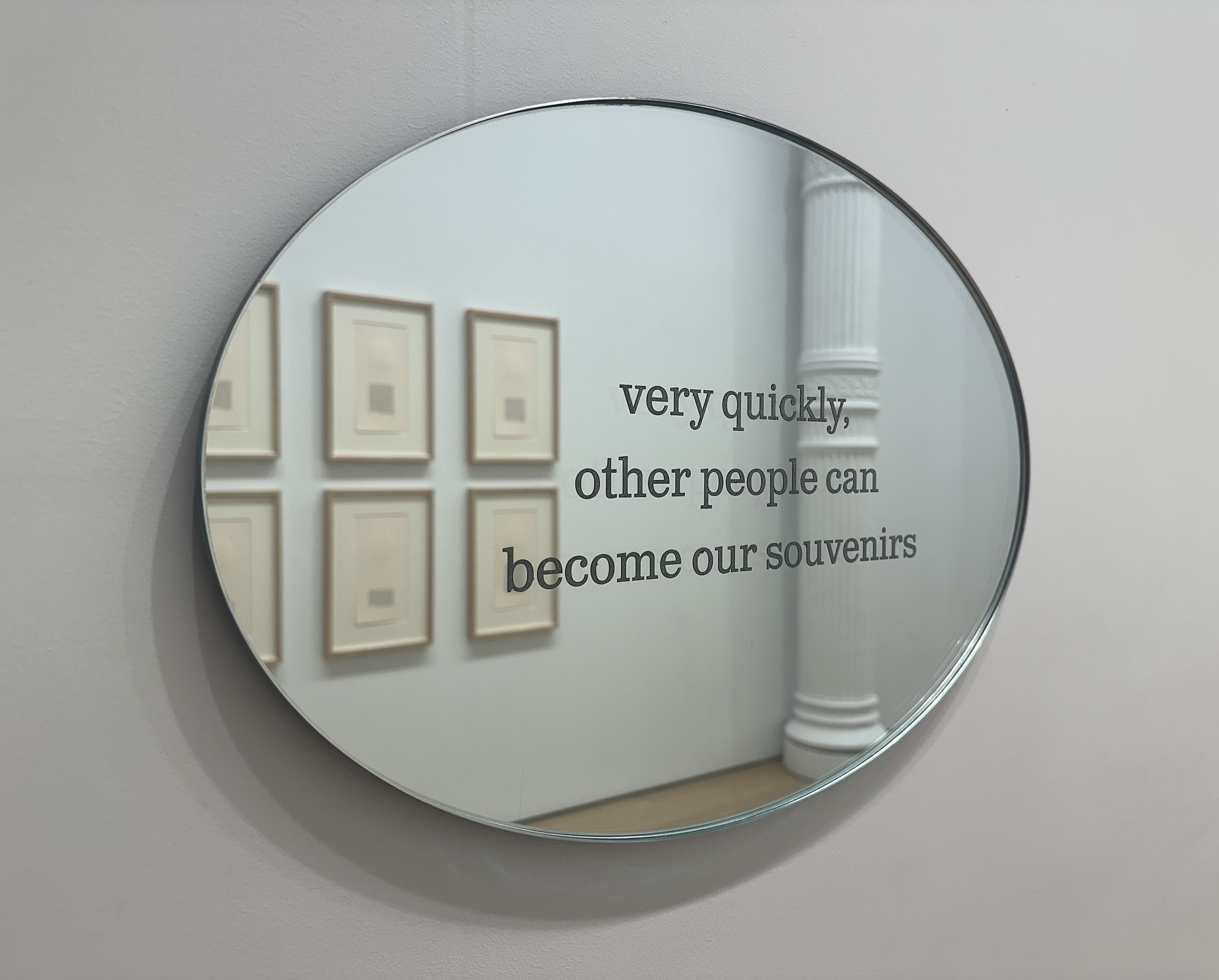
These questions bubble as much as the floor of Twice Seen, Bass’s solo exhibition at Alexander Grey Associates, devoted to O’Grady herself. Right here, Bass plumbs mixed-race life and the puzzles of visibility, double consciousness, and notion by way of two works: “we flip to time” (2024), a multi-channel video set up; and “PRETEXTS” (2025), three text-engraved mirrors hung throughout from descriptions of poetic scenes. As she advised Hyperallergic in 2023, her observe is partially rooted in a concerted effort to “emotionally attain individuals the place they’re at.” In Twice Seen, she walks the trail alongside us.

When you’ve been on TikTok within the final 4 years, you’ve seen the “mixed-girl poetry” skits and overzealous “no one ever thinks I’m Indian” movies. These annoying and, extra importantly, self-exoticizing, additive approaches to mixed-race artwork and political expression sprang to thoughts as I stepped into Twice Seen. The 2 works on view refuse to parrot such longstanding myths of mixed-race Black individuals as “tragic,” or saccharine, typically apolitical romanticizations of in-betweenness. Bass’s creative observe, grounded in her personal background as the one baby of a Trinidadian artist and poet and a Jewish psychoanalyst and translator, predates and will definitely outlive the drained TikTok clichés.
The three engraved rectangular mirrors in “PRETEXTS” drew me in instantly with their painful reality: “in a short time, different individuals can turn into our souvenirs.” Studying this sentence unleashes a flood of historic and up to date wounds, evoking the centuries-long observe of turning an individual right into a factor, dehumanized for enslavement and assortment. The next mirror nudges us to the following step: “unremarkable issues will occur, made particular by their seize.”

Every phrase has clearly been rigorously chosen and inscribed. I couldn’t assist however consider current campaigns for Western museums to repatriate artworks and human stays, and Tamara Lanier’s victory final month in her authorized battle with Harvard College to reclaim daguerreotypes of her enslaved ancestors, Papa Renty and his daughter Delia. “Seize,” too, looks like an intentional reference to the identical types of violence and co-optation that Bass is thinking about, whereas implicating pictures and visible artwork of their perpetration — and even us, the viewers, who’re caught within the mirror’s body, if just for a second or two.
The message on the third mirror factors to the long run: “the buildup of tiny moments builds the best reverence of all.” On the other wall, a set of six sheets Bass salvaged from her mom’s printing course of bears letterpress texts, narrating a scene from a movie we can’t see: a Nineteen Sixties residence video of relations dancing.

This isn’t a set of affirmations or feel-good platitudes. I took it as a problem from the artist. She’s daring us — notably these of us from multiracial backgrounds — to redefine “seize,” to take note of seemingly unremarkable issues, and refuse to show ourselves and each other into novelties.
Nothing in “we flip to time” is especially exceptional. The video set up, within the subsequent and remaining room, exhibits clips of meals and on a regular basis life filmed by American mixed-race households and projected onto 4 white partitions. Dad and mom and kids goof round earlier than a meal, cousins placed on a efficiency of “Let It Go” from Frozen, grandparents consider the following era’s cooking abilities. Every household’s residence film sparkles to life, cuts to black, and crops up on a special wall. It’s a cacophony of tender scenes that we might not count on to come across in a gallery, however it inevitably ignited my very own reminiscences of gatherings, family members, shared meals, and play. Crucially, it’s not potential to observe each scene. Some moments will slip by way of your fingers like sand, however the ones you catch are treasured.

Chloë Bass: Twice Seen continues at Alexander Grey Associates (384 Broadway, Tribeca, Manhattan) by way of July 26. The exhibition was organized by the gallery.





Leave a Reply