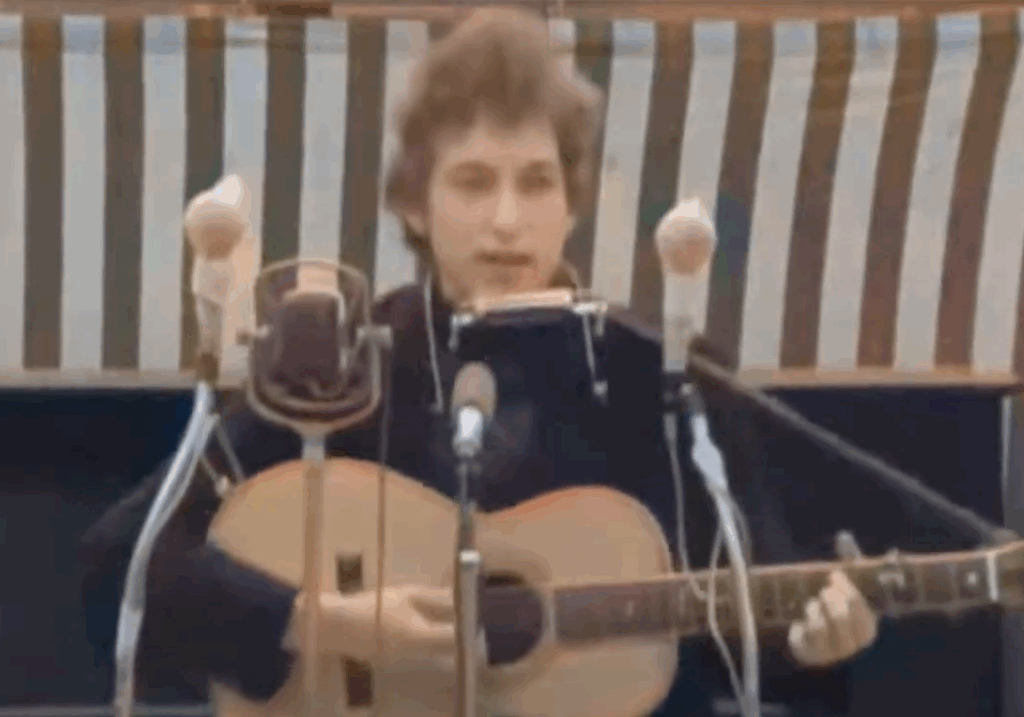
It was at the 1965 Newport Folk Festival that Bob Dylan famously “went electric,” alienating certain adherents to the folk scene through which he’d come up, but also setting a precedent for the kind of quick-change musical adaptation that he’s kept up into his eighties. At the 1964 Newport Folk Festival, however, all that lay in the future. Yet even then, the young Dylan wasn’t shy of making controversial choices. Take, for example, the choice to play “Mr. Tambourine Man,” a song that — however redolent of the mid-nineteen-sixties when heard today — would hardly have been topical enough to meet the expectations of folk fans who regarded the music’s topicality as its main strength.
At the top of the post, you can watch colorized footage of Dylan’s performance of “Mr. Tambourine Man” at the 1964 Newport Folk Festival; the original black-and-white clip appears below. Consider the resonances it could have set off in the minds of his youthful, clean-cut audience: Rimbaud? Fellini? Lord Buckley? Mardi Gras? Confessions of an English Opium-Eater? Dylanologists have suggested all these sources of inspiration and others. It is possible, of course, that — as Dylan himself once said — the lyrics’ central image is that of guitarist Bruce Langhorne, who played on the song as recorded for Bringing It All Back Home, a musician then known for his ownership of a gigantic tambourine.
Despite its lack of references to the issues of the day, “Mr. Tambourine Man” reflects its historical moment with a clarity that few songs ever have. (Some would say that’s even truer of The Byrds’ cover version, a radio hit that came out just a month after Dylan’s original.) Dylan himself must have sensed that it marked not just the peak of an era, but also that of his own compositional and performative efforts in this particular musical style. Though he did attempt to write a follow-up to the song, its failure to cohere showed him the way forward. Dylan still plays it in concert today, and to enthusiastic reception from his audiences, but in such a way as to reinvent it each time — knowing that he both is and is not the same man who took the stage at Newport those sixty years ago, and that “Mr. Tambourine Man” both is and is not the same song.
Related content:
Bob Dylan’s Historic Newport Folk Festival Performances, 1963–1965
Watch Bob Dylan Make His Debut at the Newport Folk Festival in Colorized 1963 Footage
How Bob Dylan Kept Reinventing His Songwriting Process, Breathing New Life Into His Music
How Bob Dylan Created a Musical & Literary World All His Own: Four Video Essays
“Mr. Tambourine Man” & Other Bob Dylan Classics, Sung Beautifully by Kids
Based in Seoul, Colin Marshall writes and broadcasts on cities, language, and culture. His projects include the Substack newsletter Books on Cities and the book The Stateless City: a Walk through 21st-Century Los Angeles. Follow him on the social network formerly known as Twitter at @colinmarshall.





Leave a Reply