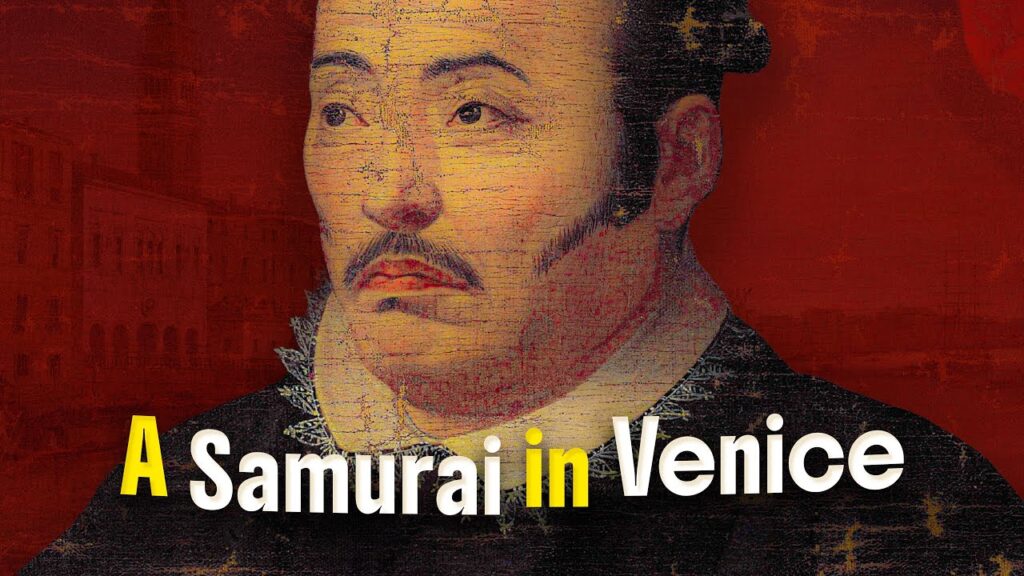
It wouldn’t surprise us to come across a Japanese person in Venice. Indeed, given the global touristic appeal of the place, we could hardly imagine a day there without a visitor from the Land of the Rising Sun. But things were different in 1873, just five years after the end of the sakoku policy that all but closed Japan to the world for two and a half centuries. On a mission to research the modern ways of the newly accessible outside world, a Japanese delegation arrived in Venice and found in the state archives two letters written in Latin by one of their countrymen, dated 1615 and 1616. Its author seemed to have been an emissary of Ōtomo Sōrin, a feudal lord who converted to Christianity and once sent a mission of four teenagers to meet the Pope in Rome — a mission that took place earlier, in 1586.
So who could this undocumented Japanese traveler in the fifteen-tens have been? That question lies at the heart of the story told by Evan “Nerdwriter” Puschak in his new video above. The letter’s signature of Hasekura Rokemon would’ve constituted a major clue, but the name seems not to have rung a bell with anyone at the time.
“In 1873, there was likely no one on planet Earth who knew why Hasekura Rokemon was in Venice in 1615,” says Puschak. The reasons have to do with the arrival of Christianity in Japan — or at least the arrival of the first major Jesuit missionary — in 1549. Not every ruler looked kindly on their work, and especially not Toyotomi Hideyoshi, who ordered them removed from the country in 1587 and later had 26 Catholics crucified in Nagasaki.
Hideyoshi was succeeded by the more tolerant Tokugawa Ieyasu (1543–1616), during whose rule the Japanese-speaking Franciscan friar Luis Sotelo arrived in Japan. Over the ensuing decade, he worked not just to spread his faith but also to build hospitals, one of which successfully treated a European concubine of the feudal lord Date Masamune. The two men got on, realizing the mutual benefit their relationship could bring: perhaps Sotelo could found a new diocese in Date’s northern territory, and perhaps Date could establish links with the Spanish empire. In order to accomplish the latter, he had a ship built and a team assembled for a mission to Europe, including Sotelo himself. He sent with them a loyal retainer, a samurai by the name of Hasekura Rokemon — or to use his full name, Hasekura Rokuemon Tsunenaga, previously featured here on Open Culture for his meeting with the pope and adoption of Roman citizenship. He may have been Japanese, but a mere tourist he certainly wasn’t.
Related Content:
The 17th Century Japanese Samurai Who Sailed to Europe, Met the Pope & Became a Roman Citizen
21 Rules for Living from Miyamoto Musashi, Japan’s Samurai Philosopher (1584–1645)
A Mischievous Samurai Describes His Rough-and-Tumble Life in 19th Century Japan
How to Be a Samurai: A 17th Century Code for Life & War
Hand-Colored 1860s Photographs Reveal the Last Days of Samurai Japan
Meet Yasuke, Japan’s First Black Samurai Warrior
Based in Seoul, Colin Marshall writes and broadcasts on cities, language, and culture. His projects include the Substack newsletter Books on Cities and the book The Stateless City: a Walk through 21st-Century Los Angeles. Follow him on the social network formerly known as Twitter at @colinmarshall.





Leave a Reply