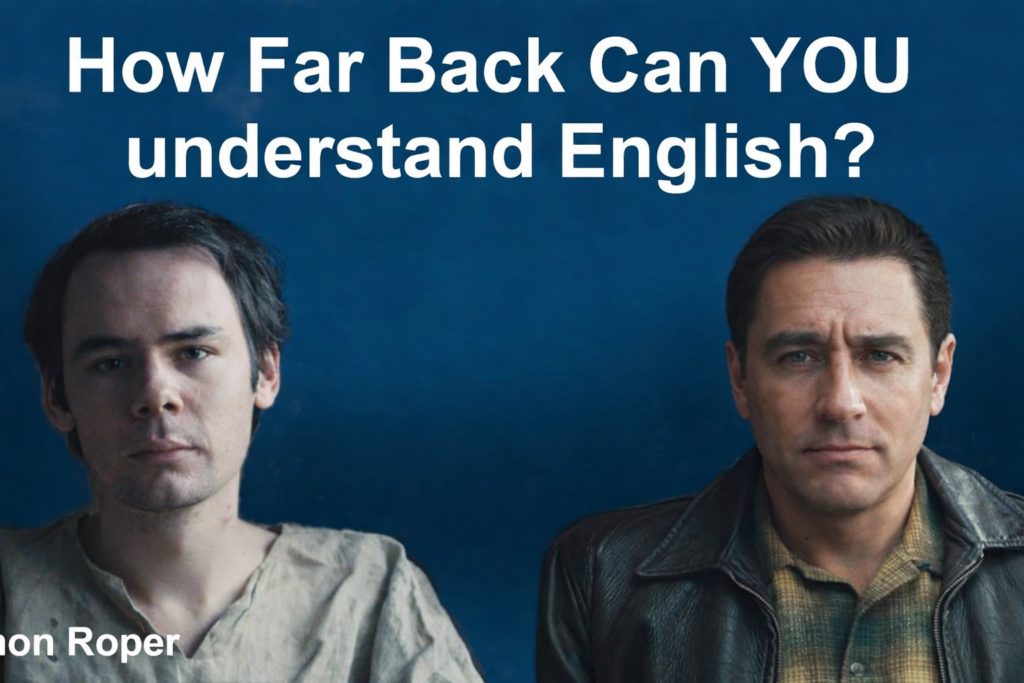
It’s easy to imagine the myriad difficulties with which you’d be faced if you were suddenly transported a millennium back in time. But if you’re a native (or even proficient) English speaker in an English-speaking part of the world, the language, at least, surely wouldn’t be a problem. Or so you’d think, until your first encounter with utterances like “þat troe is daed on gaerde” or “þa rokes forleten urne tun.” Both of those sentences appear in the new video above from Simon Roper, in which he delivers a monologue beginning in the English of the fifth century and ending in the English of the end of the last millennium.
An Englishman specializing in videos about linguistics and anthropology, Roper has pulled off this sort of feat before: we previously featured him here on Open Culture for his performance of a London accent as it evolved through 660 years.
But writing and delivering a monologue that works its way through a millennium and a half of change in the English language is obviously a thornier endeavor, not least because it involves literal thorns — the þ characters, that is, used in the Old English Latin alphabet. They’re pronounced like th, which you can hear when Roper speaks the sentences quoted earlier, which translate to “The tree is dead in the yard” and “The rooks abandoned our town.”
The word translate should give us pause, since we’re only talking about English. But then, English has undergone such a dramatic evolution that, at far enough of a remove, we might as well be talking about different languages. What Roper emphasizes is that the changes didn’t happen suddenly. Non-Scandinavian listeners may lack even an inkling that his farmer of the year 450 is talking about sheep and pigs with the words skēpu and swīnu, but his final lines, in which he speaks of possessing “all the hot coffee I need” and “friends I didn’t have in New York” in the year 2000, will pose no difficulty to Anglophones anywhere in the world. Even his list of agricultural wealth around the early thirteenth century — “We habben an god hus, we habben mani felds” — could make you believe that a trip 600 years in the past would be, as they said in Middle English, no trouble.
Related Content:
Tracing English Back to Its Oldest Known Ancestor: An Introduction to Proto-Indo-European
Hear the Evolution of the London Accent Over 660 Years: From 1346 to 2006
What Shakespeare’s English Sounded Like, and How We Know It
Where Did the English Language Come From?: An Animated Introduction
A Brief Tour of British & Irish Accents: 14 Ways to Speak English in 84 Seconds
The Entire History of English in 22 Minutes
Based in Seoul, Colin Marshall writes and broadcasts on cities, language, and culture. His projects include the Substack newsletter Books on Cities and the book The Stateless City: a Walk through 21st-Century Los Angeles. Follow him on the social network formerly known as Twitter at @colinmarshall.



Leave a Reply