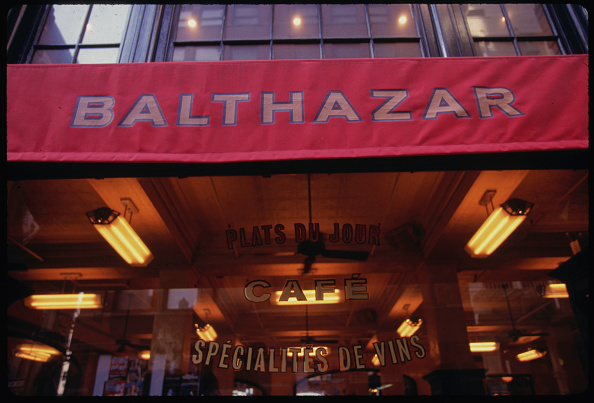
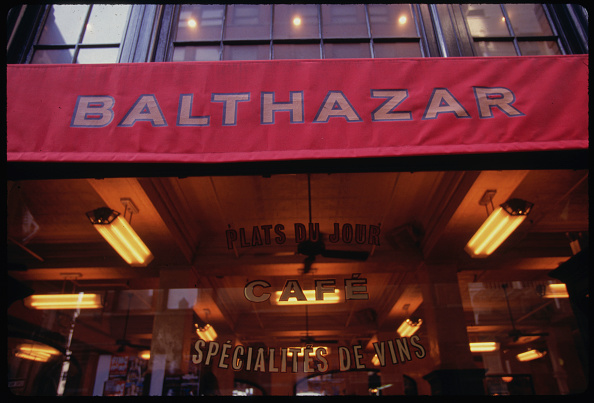
Balthazar in the nineties. Photo by James Leynse/Corbis, via Getty Images.
It was lunchtime at the restaurant. Sunlight streamed through the blinds, cutting the halogens from the side so you could see everyone’s lines and shadows and they could see yours. It was loud, and the air between me and the customers was caffeinated. Lunches were always rush, rush, rush. They gave us twice as many tables as they did at dinner, and I was usually behind on orders, showing up at the table pale and sweaty. At dinner, there was the wine haze. The lights were dimmer, and you could duck in and out of view. Dinner meant grappa and lingering and more time to charm the customers. At lunch, we turned our tables fast—it was the fall of 1997, and the crowds kept coming. I was twenty-six, with a bunch of other lives behind me—or beside me, or in front of me. Balthazar had just opened that April. I lied on my resume and I had the look.
I checked the floor plan. I was penciled to work the big tables. The VIP section was easy to spot, and everyone wanted a seat at the red banquettes that lined the back wall. Was this a mistake? It was probably a test. Back then, the restaurant was always testing us, and we never knew if our customers were plants.
Balthazar wanted stars from a New York Times review, and the general managers trained us to get them. One of the higher-ups (I’ll call her Debra) told us the restaurant hired an outside service to dine anonymously and rate the staff. If I hear something like this, I will approach every table with suspicion, asking myself, Are they a little too attentive? Too plainclothed? Too curious about the menu? Are they exchanging knowing glances after I mispronounce the name of a cheese or let a water glass sit empty while they thrum their fingers against it?
I smoked a lot in those days and ate Clif Bars I’d stuff into the pockets of my apron. I looked like a French maid in my uniform. I bought black loafers with the thickest heels I could find. You think restaurant work is easy? You probably don’t think that. Maybe you think it’s hard, but honestly, if you haven’t served at a place like Balthazar in the nineties, you have no idea.
The cheapest wine on the menu was the Côtes du Rhône, and everyone ordered it. I hated the Côtes du Rhône. The bottles had plastic corks that stuck in their throats, and I wasn’t strong enough to pull them out. I’d lean a bottle against my hip and step behind a chair to mask the struggle. Sometimes a customer would notice, take the bottle, and open it themselves. We’d laugh. Why were we laughing? Because I was a fake? You only got the laugh if you were young, pretty, and able to take a joke. It only worked if the customer was in a good mood and knew restaurants were theater. They could see you’d take care of them, even if you couldn’t provide the illusion of seamless service. When a customer walked in seeming insecure or out of place, I found someone else to open their Côtes du Rhône.
Before dinner service, we’d break for family meal. Then the waiters would gather on the restaurant floor, eyeing each other while Debra gave us the evening specials. We were all new at Balthazar, hired before the grand opening. A pecking order had quickly formed, and I pretended not to notice where I stood. When Debra reviewed the things we were expected to do and the things we must never ever do, I was lucky she never named me. A waiter crumbed a table into her hand. A waiter didn’t know the names of all the oysters. A waiter splashed champagne on an important customer. Clucking and sharp intakes of breath. I slid behind another server and tried to look as appalled as everyone else.
I’d been working at Balthazar for a few months when Debra pulled me aside to tell me they knew I’d lied on my resume. Was I fired? I was not. Debra said, “You’re unusually nice to the customers, so we’re keeping you. The customers think your niceness is genuine. They love you.”
Was I nicer than other people at the restaurant? I was. Was it genuine? That depends on what you mean by “genuine.” I’d kind of grown this personality, or I thought I had. Sometimes, you become the thing you’ve found you’re good at. If you’re going to be a bad waiter, you’d better be nice. I was scrambling to learn raw bar settings and listening hard as the other waiters pronounced “frisée.” I was moving too fast with a tray of drinks to show up to a table poised, so I arrived with an open face.
“We’re going to put you in the bar to bring you up to speed,” Debra said, and I remained in the bar for months. It was embarrassing to be demoted, but I found my way with a tray over my head. The bar was rowdier than the rest of the floor. Customers spilled out of the aisles, pushing tables together to order boozy half-dinners. I slid between them, keeping their drink orders straight, watching the door for dine-and-dashers, honing my service. The plants gave me good reviews. Which must’ve been how I ended up working the VIP section that day at lunch.
It was noon. The dining room was slammed, and someone I knew from one of my earlier lives walked through the door. In that life, in Los Angeles, I’d been best friends with a famous movie star. I’m not going to tell you her name because this story isn’t about her. In that other life, I had lived in the aura and fizz of the movie star’s money and fame. Or I had lived near it. If you’re not in the bubble, I’m telling you, stand next to someone who is. It feels so good, even for a moment, to give up shaping yourself to fit the world and let the world shape itself around you.
The person who walked through the door of Balthazar was a famous actress, too. I had known her when I’d lived in the aura and fizz of my famous friend—she was a neighbor, and we became friendly. This actress, M., had a new nose and looked so different I wasn’t sure it was her. My throat caught fire. I held a water bottle under the tap and studied it closely. The maître d’ pulled out some menus and handed them to the hostess. I willed him to seat M. on the opposite end of the floor.
She slid into a red leather two-seater in my section. Was she M.? Her face had changed, but I knew those eyes. They were smiley. Famous people switch on a warm shine when they want to be informal and kind in public. I had once lived close enough to fame to borrow its glow. Here’s how it’s done: They send a spotlight outward. It’s shaped like a cone, raying from their face, and it brightens everyone who walks through it. For a brief moment, you’re plucked from obscurity. You’re a soloist on their stage, and when you move out of the beam, you fall back to being their public.
Now I was in her beam, and I was slipping in and out of her public. I didn’t want to be in either of those places. I wanted to stay a white-aproned blur. You never know when someone is going to show up out of nowhere and make you question the moves you’ve made in life.
A guy I recognized, a young Broadway star, slid into her booth from the other side. I tugged at the hem of my uniform and asked what kind of water they wanted. Seven years before, our apartments had shared a wall. I’d see M. in the hallway. There she was in the laundry room, looking up from folding her towels. There she was, nodding hello on the sidewalk, and we’d get to chatting. In snapshots of memory, I saw us working out together at her gym. I saw her sitting across the table from me at a coffee shop on Beverly Boulevard. I saw us sharing laundry detergent for the coin-operated machines in our building. Now, she wanted a Perrier.
I disappeared into the restaurant roar. Did she recognize me? I wasn’t the one whose face had changed. In any case, she wasn’t letting on. In any case, the uniform makes the person. Should I have said something right as they sat down? Sound bounced off the mosaic tiles and ricocheted off the plates and glasses. Even the silverware was ringing. Table sixty-three needed cocktail forks. There were allergies at table sixty-five that needed to be entered in the computer. A diner at table sixty-one kept dropping his napkin on the floor. M.’s bottle of Perrier was waiting for me at the bar. I placed it on a tray. Table sixty-six wanted their check. I didn’t care about table sixty-six. I was still wondering if M. and I would speak. Maybe it was too late. We’d already gone through the water-ordering ritual. I’d done the bending-stiffly-at-the-waist thing, because that’s what waiters did, and nobody at the table had lifted an eyebrow. I printed table sixty-six’s check and picked up the tray.
Writing this now, in bed, almost thirty years later, I can still feel the waiterly poses in my body. I can feel my weight shift, my head tilt. I pause when I hit a mark and wait for the customer to absorb its shape and meaning. Shift, land. Shift, land. In another of my former lives, I’m a model in Japan. On a catalogue shoot, there’s a rhythm of moving and pausing, too. The list of prescribed poses forms an outline, and I glide between them, learning to improvise. Hand on hip, shift weight, flash. Arms clasped behind back, tilted head, flash. Turn away and snap back with freshly opened eyes, flash. A photographer calls out, “Act natural.” What a crazy phrase. It’s an oxymoron, isn’t it? What he means is they want ballet feet and wide eyes. “Yes, yes, good,” I hear from the blackness behind the bright lights. A tiny stylist comes forward and teaches me to cup my face with a hand and stare off into the middle distance. She does it to demonstrate. The hand on the face thing. Who does that while standing? Nobody. But it’s the eighties and you see a hand on the face in every catalog, including American ones. I imitate what I see, and something extra spills out of me. That extra is the reason I keep getting hired in Japan. Later, it will be why they keep me on at Balthazar.
M. ordered the chicken paillard. Steak frites and a Diet Coke for him. I nodded and put the pencil and notepad in my pocket, smiling at the air between them as I spun around to place their order. Did her new nose make her foreign to me? I told myself it did, that I wasn’t even sure if it was her, though my animal brain knew it was. What was it like for her to slide into the banquette, order a Perrier, and watch me not recognize her? At parties these days, I’ll lean toward an acquaintance, pat my chest, and say “Heather,” to avoid not being remembered. I’m trying, now, to put myself in M.’s shoes. I’m a famous actress who altered her appearance through plastic surgery. I’m at a party. I’m leaning in. I’m patting my chest. Or, because I’m famous, I don’t have to pat anything. I just stand there, wearing my warm shine, watching confusion play across the faces of the people looking at me. These thoughts feel awful. The point for M. of altering her face was to land leading roles—to become more recognizable, not less. I know she knew I was her server. I know she meant to spare me embarrassment.
Somewhere between pouring M.’s water and placing the bottle on the table, somewhere between setting down the plate with extra slices of lemon, I felt the moment become still. I wasn’t looking at her. I wasn’t touching the rim of the bottle to her glass. I wasn’t there. The noise between the world in which we had known each other and the world I occupied now went silent, or maybe only hushed. I mean, I wouldn’t be writing this if I couldn’t still hear it.
Heather Bursch is a visual artist who works in sculpture and video. She is an alumnus of the Whitney Museum of Art Independent Study Program and has received a MacDowell Fellowship. She is currently at work on a collection of interlocking pieces—with the working title “Imperfection Management”—about her day job as a high-end tradesperson, hired to fix scratches and flaws in the homes of wealthy people in Manhattan.





Leave a Reply