
Today’s guest post is by Allison K Williams (@guerillamemoir). Join her on Wednesday, December 10, for the online class The Secrets of Memoir Structure.
I recently spoke with a writer working on her husband’s memoir. He’d written a rough, short draft of his life story, and she planned to flesh out the scenes, expand the story, and revise in his voice, for a book for their family and community. She asked me if she’d still benefit from my class for memoirists, since she was writing someone else’s story.
Yes, she would, I assured her. Because when I teach, I separate the author in front of me from the character in the book. We talk about “the narrator,” or “Younger-Susie” or “Memoir-You” when examining the dramatic arc of the book, what scenes belong, and where choices, actions and feelings can be stronger on the page. The person on the page isn’t the person writing the book.
Memoir isn’t therapy, we agreed. While writing our story can be therapeutic, the process of revising and publishing for other readers is a craft—the therapy part should be over.
A few hours after the conversation, I realized: The person on the page can’t be the person writing the book. Because if the memoir is any good, if your life has changed enough to write about and share with others, you aren’t that person anymore.
Let’s look at this in terms of structure.
First, where does your memoir start?
Many writers start with the family history that made them think and behave as they did before they changed—a legacy of alcoholism, or a childhood spent roaming the world—but whether negative or positive, that’s usually backstory, not where the dramatic journey of the book actually started.
Instead, identify the end: who are you when the story is done? What’s different in your life?
Start the memoir in the scene where you were farthest from that new self. The place where you hit rock-bottom, or where the relationship was the worst, or you knew the least. That scene is often a lot later in your life than the scene you started your first draft with. Will you need some of that family history? Probably! But weave it in later, rather than larding your opening with backstory.
The reader doesn’t care how you got to the worst problem—they want to see you in it, and then start fixing it. Bring in the history in little bits later, to show readers why the narrator is like this, or how she came to make that choice.
Now think about the midpoint
About halfway through the book (because this is the archetypal way that humans tell stories), there’s a reversal. Either you answered the big question and that led to another, even bigger question, or everything you thought you knew was wrong—or added up to a different answer than you expected.
Chloe Dalton begins Raising Hare with a question: Can I keep an orphaned wild hare alive? At the midpoint, the answer is yes. The hare roams the woods and returns to her garden and home as it pleases. The new question, which powers the second half of the book: Now that she is aware of nature’s effect on herself, what can she learn about the effects humans have on nature?
In the beginning of Stephanie Foo’s What My Bones Know, she discovers her diagnosis: Complex PTSD, and the first half of the book explores the childhood trauma that caused that condition. At the midpoint, she realizes the source isn’t just the mother who abused her, it’s also the father who stood by—he’s the one she now needs to become estranged from.
Finally, the ending
What, in the beginning of the book, is Memoir-You seeking? Validation, a great relationship, closure? The book ends when you find it. Any more than about three pages of post-ending reflection, readers get antsy.
Often, when we start writing our memoir, we haven’t lived the ending yet. We haven’t reached the place of achievement or success or peace that makes the past okay. Your story literally hasn’t finished.
Take a look at your pages. Can you tell Memoir-You, “Hold on, you can make it, it’s going to get better when X happens”? If you can’t, you’re probably still living the journey. There’s pain and change and release yet to come. Take notes. You’ll be glad to have them when your story ends.
Memoirists have a secret weapon to find the ending of their story: write it before living it.
- Ask yourself, what would be a satisfying resolution to your journey? Write that resolution as an imaginary final chapter, as if your memoir were a novel and you’re the protagonist. What events happen? How has Memoir-You grown or changed? How is Writer-You’s life different from where you started? Who and what are still in Writer-You’s life? What has been shed or repudiated or forgotten?
- List the specific steps Memoir-You chose to move from problem to resolution, and check off any steps you’ve actually taken in your life.
- What steps remain to earn the satisfying resolution? Start carrying out those steps. If they seem insurmountable, enlist a trusted friend, a therapist, or even a writing coach to help you choose the change in your life that will conclude your memoir.
You’re allowed to write the ending you want! If you’re craving reconciliation or closure, write what that would be like. But pay attention to what feels false or like wishful thinking. If you can’t sell a resolution to yourself on the page, you’re unlikely to be able to bring it to reality. Yet, when you write the answer that is within your power, even an improbable conclusion will feel true. Perhaps it’s the hard answer, or the one that takes steps you dread (but that your writing brain knows are necessary). Writing down the destination and identifying how Memoir-You got there can bring a sense of purpose, of control over our own outcome. Clearly identifying steps that make sense in a manuscript plot allows us to take those steps in reality.
This process may sound over-simplified, but more than one writer has told me, months or years after trying this technique, “I just lived the end of my memoir!” The answer wasn’t always exactly what they’d written—but having analyzed the ending they sought, they knew when they’d reached finality.
Powerful memoirs are about the person the author used to be, not who they are now.
If the person writing the book is still the person on the page, wrestling with the same problems, navigating the same difficult relationships, lacking direction in their life, you don’t yet have a memoir. You have a series of events that are still happening. They don’t become a story—a powerful, salable story that readers will learn to change their own lives from—until you become a new person. The Author. No longer the person something happened to, but the person with the power to tell the story.
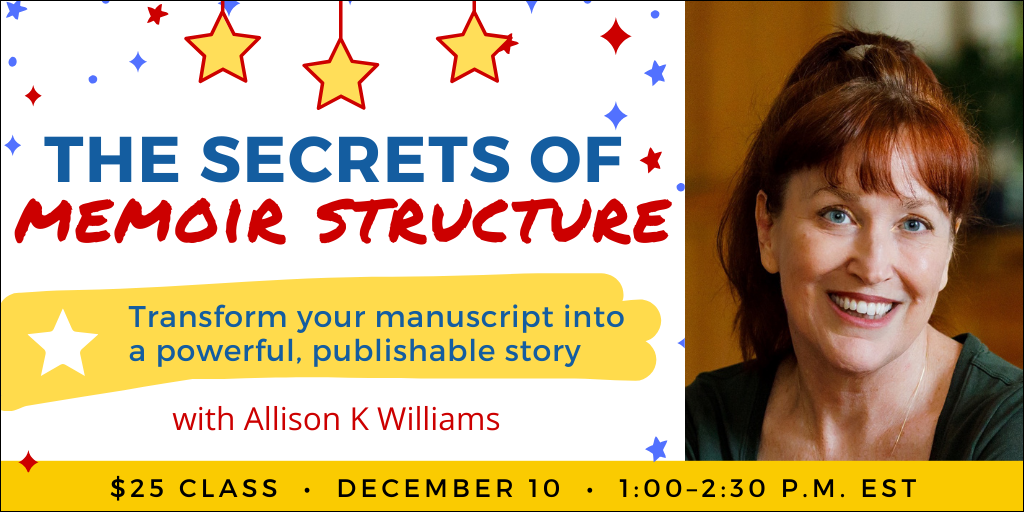
Note from Jane: If you enjoyed this post, join us on Wednesday, December 10 for the online class The Secrets of Memoir Structure.
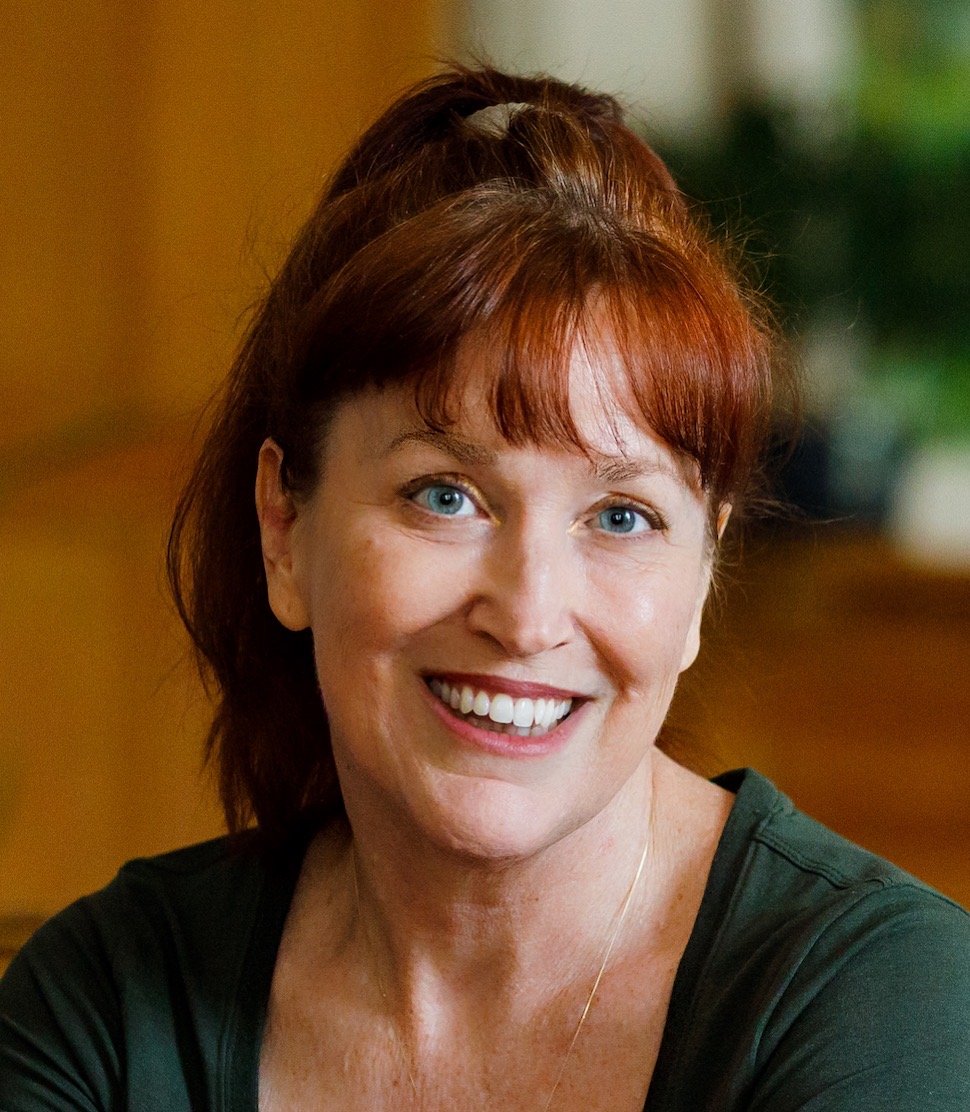
Allison K Williams has edited and coached writers to publication with many of the best-known outlets in media. As a memoirist, essayist, and travel journalist, Allison has written craft, culture and comedy for National Public Radio, CBC-Canada, the New York Times, and many more. She leads the Rebirth Your Book writing retreats series and, as Social Media Editor for Brevity, she inspires thousands of writers with weekly blogs on craft and the writing life. Allison holds an MFA in Creative Writing from Western Michigan University and spent 20 years as a circus aerialist and acrobat before writing and editing full-time. Her latest book is Seven Drafts: Self-Edit Like a Pro From Blank Page to Book (Woodhall Press, 2021). Learn more at her website.


![90 Day Fiance: Laura is Torn Between Her Bestie and Birkan – Before The 90 Days Recap [S08E01]](https://breshlynews.com/wp-content/uploads/2025/12/90-Day-Fiance-Laura-Nevenner.jpg)


Leave a Reply