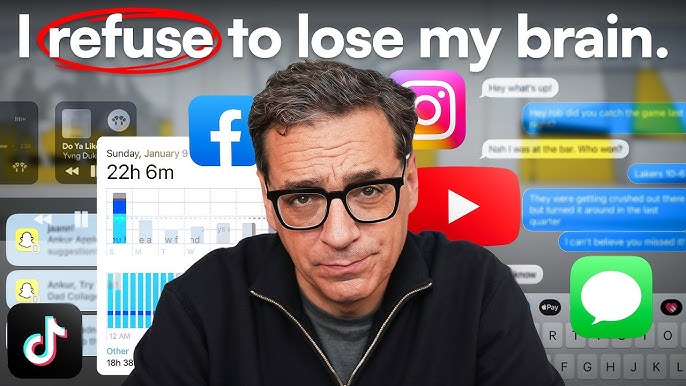
In his new video above, the writer Daniel Pink proposes the following exercise: “Grab a book and time yourself. How long can you read without getting up or checking your phone? Really try to push yourself, but don’t judge yourself if it’s only a few minutes. Write down your time; that’s your baseline.” From there, you “train your attention like a muscle: build it by starting small and gradually stretching it.” This is just one of five strategies he recommends to “fix your attention span,” a repair of which more and more of us feel in need the deeper we get into the twenty-first century. If even opening up a book sounds like a bit much, first take up Pink’s challenge of watching this four-and-a-half minute video “on full screen, 1x speed, with no distractions.”
As with any endeavor, it’s important to start small. Once you have your baseline, however you’ve measured it, you can set about improving it. In order to place yourself well to do so, Pink recommends eliminating distractions from your immediate environment, which has already been “rigged against you,” not least by social media companies: hence the importance of creating a “no phone zone,” or at least permanently turning off notifications.
Drawing on the work of Cal Newport (previously featured here on Open Culture), he also suggests creating cues — using certain physical movements, certain music, certain scents — that signal your brain to go into work mode. But even in work mode, you should make sure to take breaks, deliberately, every 90 minutes, or at whatever interval your brain starts performing like a toddler in a meltdown.
On the highest level of all, we must “reconnect attention to meaning.” In other words, we have to understand the reasons we’re doing a task, if any, before we can hope to concentrate on it. “I learned this myself on my last book,” Pink says. “I was struggling. I was distracted. I was on my phone and watching sports highlights rather than my work, and I realized the problem was that I didn’t know why I was writing this book. I didn’t have a purpose.” Only when he finally articulated the benefit of doing that work, and then posted that articulation above his desk, did it start to flow. When next you find yourself unable to stick to a task on the job, a personal project, or a book — whether you’re reading or writing one — ask yourself: Why am I doing this? Maybe the answer will empower you to attend to it. Or maybe you’ll be better off doing something else entirely.
Related Content:
How to Focus: Five Talks Reveal the Secrets of Concentration
The Surprising Power of Boredom: It Lets You Confront Big Questions & Give Life Meaning
Why You Should Only Work 3–4 Hours a Day, Like Charles Darwin, Virginia Woolf & Adam Smith
Medieval Monks Complained About Constant Distractions: Learn How They Worked to Overcome Them
Based in Seoul, Colin Marshall writes and broadcasts on cities, language, and culture. His projects include the Substack newsletter Books on Cities and the book The Stateless City: a Walk through 21st-Century Los Angeles. Follow him on the social network formerly known as Twitter at @colinmarshall.



Leave a Reply