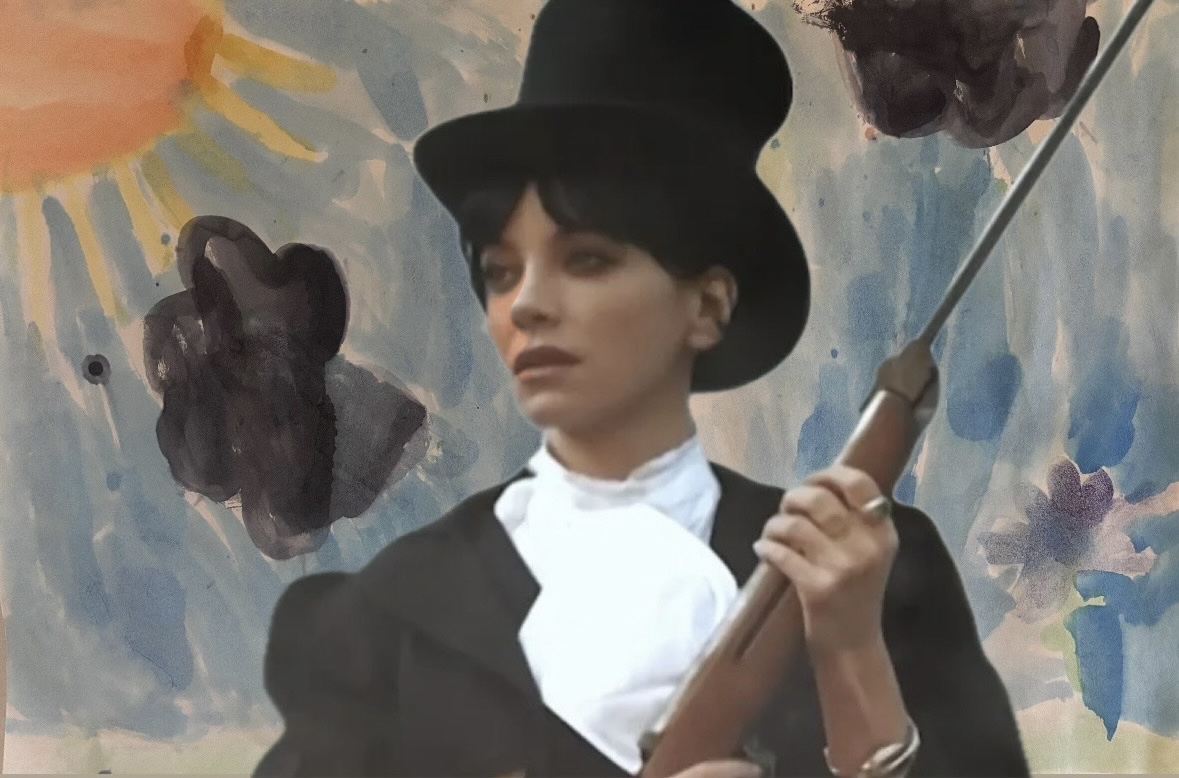
Lily Allen. Photograph courtesy of Jean Garnett.
“Who is Madeline?” asks my daughter. We’ve been singing that new Lily Allen song all morning—“Da da da da da da da who’s Madeline?”; we can’t get it out of our heads. How should I answer? Madeline seems to be a woman with whom the singer’s husband is having an affair? Then I’ll have to explain what an affair is. And wait, “affair” isn’t the word, since Allen and her husband had an open marriage, though the song tells us he’s “broken the rules” of their arrangement with Madeline … Anyway I’m not going to try to explain nonmonogamy to a seven-year-old.
By a stroke of genius, I hit on the right answer: “I don’t know.” My daughter seems to need no further clarification on the issue, but I’m realizing that I do, actually. That is, I want to understand why for some reason, despite Allen’s deft and amusing sketch of this Madeline person as a vacuous, woo-woo home-wrecker, I feel a certain sympathy with her. I care about Madeline, about her desires and her right to pursue them without being villainized.
West End Girl, Lily Allen’s first album in seven years, is a pop marital memoir chronicling the dissolution of Allen’s partnership with the actor David Harbour in the wake of their agreement to try out nonmonogamy. I get why people are in raptures over this record. There’s a certain phoenix-from-the-ashes satisfaction in seeing a romantically wounded, no-longer-young woman artist explode back into the spotlight with a series of sexy, delectable bops: we love that for her. There’s the earworm indelibility of Allen’s tunes that has my kid humming them while brushing her teeth, the charm and humor of her lyrics, and the generosity of her voice, which confides in us like a friend: we love her for that. She’s very lovable.
Does it follow that her husband, and his “Madeline,” must be hateable? Because, whether Allen intended it or not, that appears to be one takeaway here. West End Girl has been described approvingly as a revenge album, and the consensus among fans seems to be that Allen sure got Harbour’s ass good, that in the process of transmuting her pain into art she has served him a much-deserved pillorying. Remind me why he deserves this? It does sound from the lyrics like there was dishonesty on his part, but his original sin, in the story of Allen’s record, is that he open-marriaged her.
The idea of straight open marriage as a thing done by men to women rings a bell. In 2022, after I published an essay on this website about opening my own marriage, many commenters expressed a rage at my then-husband that discounted my ability to consent to the terms of my own life. “I couldn’t get past my fury,” wrote one reader, “… [that] her asshole husband decides he needs new pussy. Fuck that dude.” Many called him a bad father simply for being a man in an open marriage (in fact he is a devoted father and was doing more than half the childcare at that time). Despite my essay being, to my mind, a celebration of the possibilities that nonmonogamy opened for me—as a mother, as a writer, as a sexual being—an alarming number of readers were determined to apprehend it as a story about the domesticity-destroying capacities of the male sex drive. These people seemed to understand nonmonogamy as an inherently coercive male prerogative that vies with the female, maternal, “family values” prerogative of monogamy.
I intend no disparagement of West End Girl in wondering aloud whether its popularity is bolstered by its adherence to this archetype. Whatever else it is (frequently delightful, well crafted), West End Girl strikes me as a rather neat, crowd-pleasing, bias-confirming presentation of nonmonogamy that casts male extramarital libido as the bad guy and Allen as the victim who just wants to be allowed to go about the business of being a good wife. On the night of the “Madeline” revelation, in the song “Tennis,” Allen has “got the dinner on the table”; she’s made her husband’s favorite meal. In an earlier track, we hear only her side of the phone conversation in which her husband seems to request an open arrangement, and those snatches of dialogue suggest that this boldly expressive woman has no voice, no will, no option to reject her man’s proposition. We can hear her holding back tears as she says, “I want you to be happy.”
What is lost, or glossed, in this presentation? Earlier this year, I published another essay about leaving my own open marriage to pursue an unavailable man whom I desperately wanted, emotionally, spiritually, physically. “Dumb cunt, kill yourself,” one stranger wrote to me. Sick horny bitch busted uggo retard spinster hag degenerate slut whore were some of the names I was called. (Also “chopped shit,” a curious epithet in that, as something to be, a pile of shit is not made worse by chopping. Is it?) Hundreds of male readers expressed outrage and disgust that I could dare to desire men who weren’t my husband while being, as a mother over forty, definitionally undesirable to them. A female “reporter” for the New York Post described me with cautionary “it’s 10 P.M. do you know where your children are?” gravity as “a woman who has decided to pursue open relationships, casual sex and situationships into middle age.”
Is it possible that we default to a view of straight open marriage as a husband’s imposition on a passive wife in part because we are, as a culture, still threatened by a mother’s extramarital desire? Is it possible that the double standard of female aging articulated by Susan Sontag in 1972 requires zero revision half a century later? Men are expected to go on wanting forever, while for women, “the time at which they start being disqualified as sexually attractive persons is just when they have grown up sexually.” Are we so viscerally uncomfortable with the force and clarity of a middle-aged woman’s libido that we refuse to conceive of open marriage as potentially liberating for wives?
This past week, a newspaper editor got in touch with me asking if I would care to join the buzzy conversation around West End Girl by spitting out a thousand words on “why open marriage doesn’t work.” I did not care to; I do not see open marriage as an unworkable model—certainly no more so than monogamous marriage. Inviting other lovers into a marriage is a lot like bringing a child into it: both openings unearth a relationship’s buried conflicts, and plenty of marriages are going to buckle under the pressures of nonmonogamy just as they do under the stresses of having young children. In my own case, open marriage did “work,” in that my marriage needed to end. Sometimes destruction is precisely the work that needs to happen.
I would love to hear a version of West End Girl in which a wife not only heartily consents to and partakes of openness but sings her heart out as she stands under the cascading consequences of her own desire. Because there are always consequences; that is what we open to when we open a marriage, and no provisos, no “rules” can fully insulate us from them. Maybe part of our discomfort with nonmonogamy is bound up in a teaching that “good” romance is safe romance, and that we deserve and owe each other emotional safety. We do not; in our hearts we know this, and in fact part of open marriage’s appeal, and part of its expansive potential, is precisely in how it makes us less safe. The pursuit of desire is a dangerous, vulnerable business; like Roy Orbison sang, love hurts. We can be thankful for this. Where would we be as a species without the mind-altering pain that reckless passion and tenderness and sex and betrayal can cause, the way they can dismantle and force us to rebuild more honestly? What would our art be, what would our music be, if loving was safe?
I’m listening right now to a song my ex-husband sent me a few weeks ago, “Au Pays du Cocaine,” by the band Geese. The song’s lyrics were written by the band’s frontman, Cameron Winter, whose mother, Molly Roden Winter, wrote More, a best-selling memoir of open marriage that attracted many critiques, not only of its author’s blinkered privilege (some have argued that openness is a luxury, and certainly Allen could be a case in point there) but charging that she had been unwittingly open-marriaged by her husband. “You can change,” Winter bellows in that nauseous bass of his, “baby you can change and still choose me … you can be free, just come home, please.” It’s one of the most elegant enjambments of the mess happening inside human longing that I’ve heard—a mess, eternally unrevised, of competing drives for safety and freedom, for chosenness and a self-determining changeability that may at any second defy choice. Of course, I know nothing about this young man’s personal life, but listening to this song, I find myself speculating on how his parents’ transparent grappling with that mess may have influenced him. (Am I being presumptuous? Very well then, I’m being presumptuous; that’s the fun of speculation.) It all gets me thinking: open marriage doesn’t have to either preserve a “good” marriage or dissolve a “bad” one to be “successful.” It might just help produce some great songs. And maybe draw us closer together? Not necessarily as couples, but as a community in endless struggle with what feels impossible about intimacy, what we are suppressing, what we have relegated to fantasy, what is driving us mad, what is hurting.
Allen’s new music is groovy with hurt, and I can’t help being happy for her from afar that her safety measures failed. One stipulation—that her husband’s affairs had to be with sex workers (“there had to be payment,” Allen sings in “Madeline”)—suggests, to me, a vaguely dehumanizing notion of sex work as somehow cordoned off from human interaction, rendering a partner’s dalliances “safe,” all business, nothing personal. But the personal will out; it bursts upon her in that name, “Madeline,” whose specific reality Allen cannot, at first, “even process.” She does process it, though, and she puts it to work. For me it is precisely the incursion of the grittily personal into her music—the brusque, meat-and-potatoes diarism of “dinner on the table, tell the kids it’s time to eat” and “Duane Reade bag with the handles tied” and “I wrote a little email”—that draws these airy, catchy tunes down into experience.
I wonder what Madeline is experiencing. “Who is Madeline?” Whoever she is, I hope she’s out there getting hers.
Jean Garnett has published essays in The New Yorker, The New York Times Magazine, The Paris Review Daily, and The Yale Review. A winner of the Pushcart Prize, she is at work on a book about relationships.



Leave a Reply