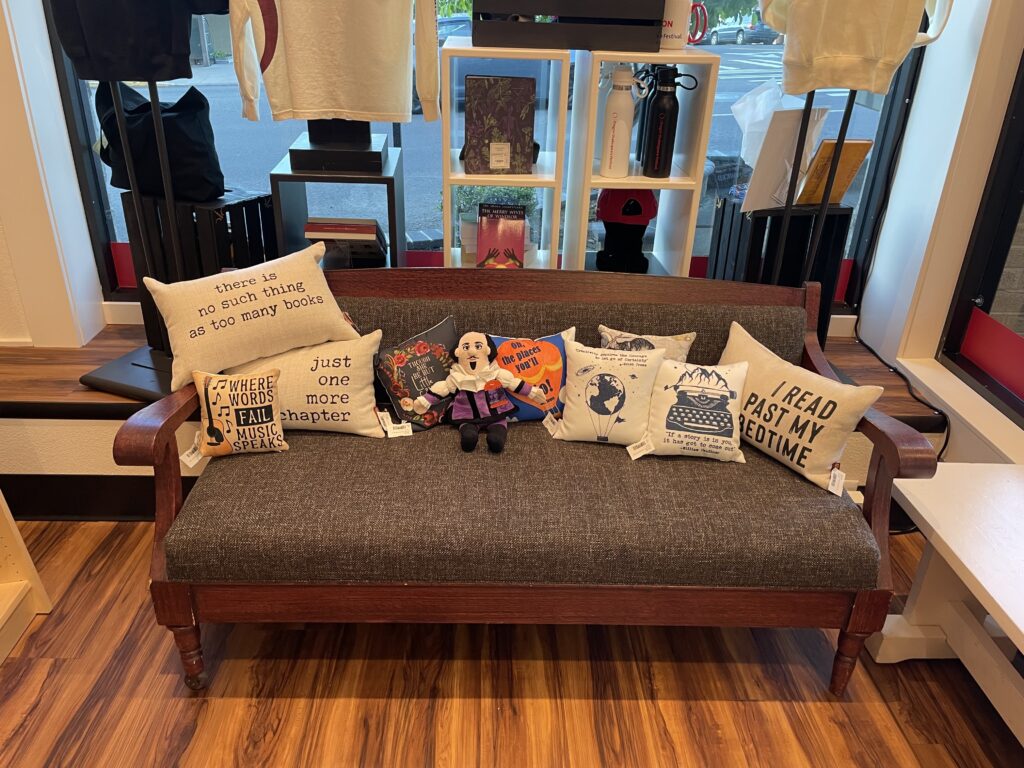
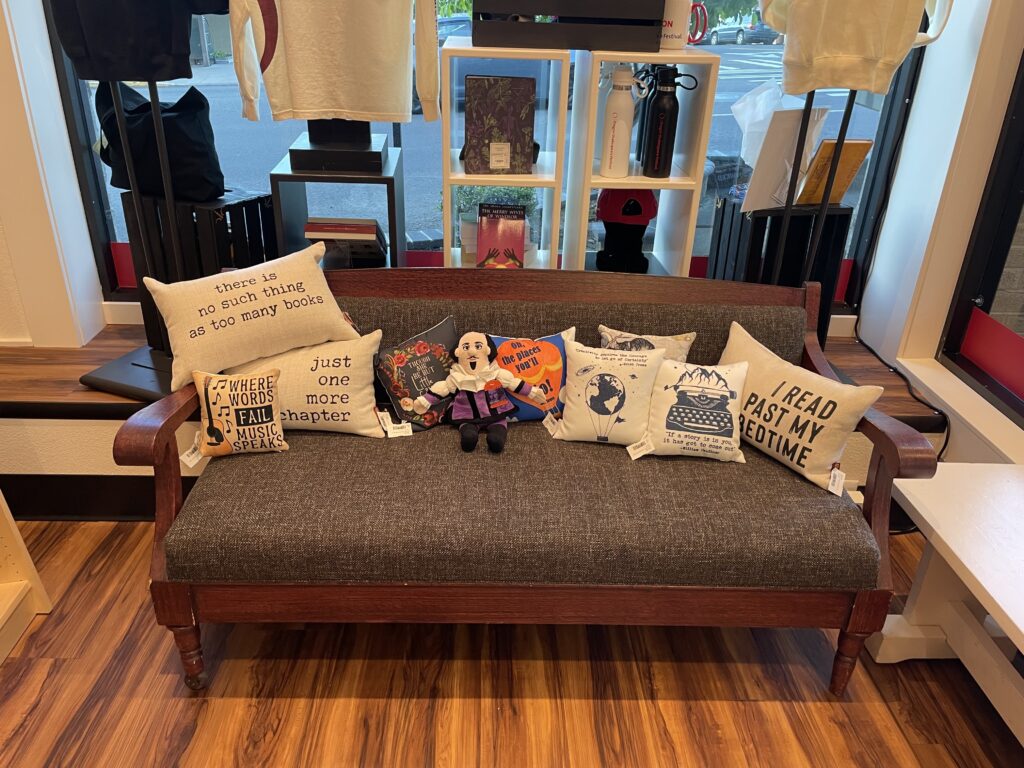
Photograph by David Schurman Wallace.
The old people are going apeshit for the mariachis. My dad and I are sitting on a bench in the plaza at the bottom of the hill, killing time before the next play. We were hoping to do a little reading, but then, under the light of a half moon shaded by trees, the musicians appeared and started playing a promotion for the reopening of a nearby Mexican restaurant. A crowd appeared from thin air: the ranks of the silver-haired and still-fit, the perennial window-shoppers of this cultural oasis, who show more enthusiasm for this advertisement than for any of the Shakespeare plays we’ve been to so far. They take a lot of pictures on their phones of the brass-buttoned musicians, who put in their work. They try to clap along. A couple even dances for a song or two: a dip, a twirl, more applause. Romance never dies—its definition only degrades.
For several years when I was growing up, my family drove to Ashland for the Oregon Shakespeare Festival. In Ashland, the main drag of olde-time, small-town storefronts fold into the surround of rolling evergreen hills; an actual babbling brook, complete with footbridge, runs through it. Ashland is a certain kind of cultural haven for those who mute their wealth tastefully under their shawls. With a complex of three theaters at its heart, it hosts a ninety-year-old institution dedicated to spreading the word of the Bard all summer long. As a child, I was always soothed sitting in the darkness, where everything felt perfectly in order. One scene stitched into the next, the actors hit their lines, and together we headed toward marriage or death.
It began as a nostalgia trip. My parents hadn’t been since before the pandemic, and for me it had been even longer. A combination of COVID and wildfires had threatened to bankrupt the festival, so we agreed it was time to both support and take stock. And my parents are getting older—who knows if we’ll ever do it again. On our drive, we see the dead skeletons of trees still left after the burning, with new greenery coming up in their shadows.
My dad, cheerful enough but fatigued, maybe, from the day’s first show, says that we can just park him anywhere, that he’s going to finish reading tomorrow’s play, August Wilson’s Jitney. I linger with him near the town’s fountain. Ashland is supposedly known for its famous Lithia water. I examine the sign: the natural spring source can poison you (“contains elevated levels of Barium—daily consumption is not recommended”). The town’s founders hoped the water’s alleged healing properties would create a tourist destination, but the water tasted awful and its mineral residue clogged the old pipes. You can still get some at the fountain in the square. I’d describe it as yeasty-tasting with an unpleasant smell. For subsequent tourists, Shakespeare would have to do. People come to be healed in a different way now, to enter the high church of Art, if only to stand around in the back pews for a few minutes.
The band plays on, and my dad tunes it out. We don’t speak. I feel a bit like a Thomas Bernhard character, wallowing in my low opinion of my fellow man. Nothing in particular against mariachis, but this scene is just bulk storage on these people’s devices, never to be looked at again. There’s a Ren Faire energy here now, but without the benefits of the Renaissance. A snatch of trumpet melody from the musicians, just playing their part, becomes another input into the scroll-in-progress. Who will miss all this when it’s gone?
FIRST DAY
One pleasure of Shakespeare is that every era projects itself into him. As the critic Harold Goddard wrote more than seventy-five years ago in The Meaning of Shakespeare (God, if we could name our books so confidently now …), “One by one all the philosophies have been discovered in Shakespeare’s works, and he has been charged—both as virtue and weakness—with having no philosophy. The lawyer believes he must have been a lawyer, the musician a musician, the Catholic a Catholic, the Protestant a Protestant.” In some sense it doesn’t matter what we say about Shakespeare—he gives us an occasion to talk about ourselves. What, then, is the meaning of Shakespeare in the Rogue Valley, a little liberal enclave in the forest?
We arrived in the evening, met my aunt, a therapist who also traveled up for the festivities, and had dinner (along with the best margarita in southern Oregon, some say). Everything in Ashland is encased in the amber of the upper-middlebrow: there’s one fancy hotel with an oddly Palm Springs–esque restaurant, several bistros with so-so food and elaborately-named beers (“Drink Me Potion” Fruited Sour), boutiques where men buy sun-shielding hats and women buy comfortable sandals, and places for people to “nourish themselves with artisan pastries and Direct Trade coffee,” as one bakeshop puts it. The Shakespeare fanfare isn’t too ostentatious around town; the knowing have been coming for years to stay at the Bard’s Inn and the Stratford. At the gift shop, my mom looks for a wacky T-shirt to buy my nephew and complains that the merchandise has become too standardized with the Festival’s logo, presumably an effort to build its Brand. Even if kitsch has been mostly ousted, you can still buy a I READ PAST MY BEDTIME throw pillow or a surplus prop from last year: “take a piece of LIZARD BOY set home with you / $5.00 each.”
The complex of three Shakespeare theaters, including a full reproduction of Shakespeare’s own Globe (a sign in faux-Gothic script proclaims it “America’s First Elizabethan Theatre”) is up a decently steep hill. The complex is efficiently run, with ticket-takers, impromptu music, and restaurants where tired patrons can be easily deposited after their journey in the dark. My dad’s leg is hurting him, so we decide to try out his wheelchair. Over the last few years, both of my parents’ ability to walk long distances has declined. Pushing my father in a wheelchair, even a temporary one, marks the time gone. (The infinitely kind ushers are ready with the kind of chitchat that alleviates some awkwardness—”So sporty that your wheelchair is red!”—and this both soothes and aggravates me.) Being temporary, the chair is also flimsy, not suited for an old public sidewalk, with little wheels that constantly risk lodging the chair in ruts or grooves and throwing my father to the ground. More than once I think I see him putting his head in his hands in what looks to me like a rare sign of emotion.
Filing into the matinee performance of Julius Caesar, what makes the biggest impression on me is the audience. They are old. At least two phones, full-volume ringtone, go off during every performance. As the play progresses, eyes close, postures slouch.
It’s a fairly boilerplate production, except it has an all-woman cast. Maybe because it’s a play so often taught in schools, there’s a temptation to stick to what people know. Brutus is mild, and Caesar has been dressed in white fatigues, a cape, and a red beret, some cross between Las Vegas magician and Hugo Chávez. In a play about empire and insurrection, images of contemporary politics are bound to figure. It’s one of the ways we speak our time into Shakespeare, draw his political imaginary into our own. It leads us back to the particular in the universal, even at the risk of an insipid flattening. (I have attended Shakespeare in the Park and seen the Stacey Abrams sign in a backdrop window, a flourish they repeated the following year when she wasn’t even running for office.) Trump as Caesar, sure. But Caesar is also a figure of illness; he has epilepsy, “the falling sickness.” His body is always betraying his immortal ambitions. Perhaps a little Joe Biden rattling around in there too? But no one goes there. Maybe the production’s limpness—my eyes glaze over during the choreographed fighting and dancing—is in the inability to find a coherent liberal narrative in a play that suggests assassination might be desirable.
Regional theater, man. You want it to continue to exist, but you don’t always want to be the one who has to sit through it. Part of the problem with reading Shakespeare is that performance rarely equals the text. If you see enough plays, you know the standard tactics that productions everywhere use to keep the audience “in it”: shouting as a substitute for passion, leaning heavily on Shakespeare’s bawdy puns (this year we’re spared the actors jerking off in pantomime), enlisting the audience to clap along. The text often gets tweaked to make sure we stay oriented, a bit like bowling with bumpers. The next day, when an actor shouts “Give me a break!” in reply to a fatuous speech, I’m fairly sure the line isn’t one of Shakespeare’s.
I’m disappointed most by the performance of Cassius, that slippery arch-plotter, another of the yellers. Her eyes wide, her teeth bared, she stands firmly planted to deliver her lines. The flip side of Shakespearean universality: there are so many characters who don’t let us understand why they do what they do. When Cassius tells the story of saving Caesar from drowning (“Help me, Cassius, or I sink!”), isn’t there a mysterious hurt there when he says, “Cassius is / A wretched creature and must bend his body / If Caesar carelessly but nod on him”? Caesar is obviously a father figure, striding over us like a Colossus. Set aside the Freudian thing for a moment. Cassius wants power, of course, but there’s more. There’s compassion inside Cassius’s story, the near-tenderness by which body raises body, and the speech shivers to life. It’s a complex feeling to recognize the frailty of your enemy. Even the strongest of us become helpless, often before we realize it. There’s an image from another epic inside Cassius’s speech: Anchises, the father of Aeneas, carried on the back of his son as they leave the burning ruins of Troy. We all swim in the waters of time, and we don’t know when our bodies or minds will give out. Suddenly, we find ourselves carried.
After one of the plays, we squeeze the wheelchair into an elevator with a man in a gray T-shirt. In the way people do when they want to banter in an elevator, he looks at us and says, “It’s like Groucho Marx said about the woman who told him she had ten children: ‘Lady, I love my cigar, but I take it out of my mouth once in a while.’ ” I’m not exactly sure how this relates, but I think about it. I keep thinking about it for a while.
SECOND DAY
I spend most of the morning reading As You Like It in the hotel breakfast area over a plate of powdered eggs. Nobody said I wasn’t a procrastinator. For the matinee, we see Fat Ham, a loose adaptation of Hamlet that won the Pulitzer Prize in 2022. It takes place at a cookout—the family business is barbecue—where the would-be prince is visited by his father in a white sheet with eyeholes. Hamlet is queer, Ophelia is queer, Laertes is queer. Loose reimaginings of Shakespeare can work: Where would the nineties teen romcom be without them? It does surprise me when the lead bursts out into a full rendition of Radiohead’s loser anthem “Creep.” Bizarre, but weirdly effective. The actors sell everything as hard as they can.
At Caesar, an older man—silver-haired in a purple polo shirt, still vigorous—had been sitting behind us, discoursing to his two women companions. “When they talk about ‘woke,’ ” he said, “it means that they feel defensive. They feel bad about themselves, and then they want to take it out on other people.” Maybe, though when I watch these modern renditions, I feel the drip of self-satisfaction more than anything. As long as I’ve been going to see Shakespeare, he has been a harbor for the politically correct. This says something about liberal politics and its seizure of the canon, sure, but it also says something about the playwright’s essential generosity. Call it the “dyer’s hand,” that ability to remove a singular interpretation and let all the dueling voices echo and intertwine. Diversity is inside the plays from the beginning—anyone might inhabit the words and infuse them with their own voice. But in Fat Ham, a direct monologue about inherited intergenerational trauma lands with the thud of received wisdom. The strange friction of Shakespeare’s thinking about fathers and sons is reduced to a formula.
The play winds up with a happy ending (and a drag show to boot), as the characters ask us if we deserve better than tragedy. We’ve been doing this, too, as long as Shakespeare has been performed, perhaps most famously in a 1681 revision of King Lear by Nahum Tate: Cordelia marries Edgar, and everyone can feel good on the way home. I think there’s still something more subversive in Shakespeare’s protean originals. Isn’t Hamlet a little on the side of madness of revenge? Maybe “not to be?” is more than the rhetorical question that we take it for. I’m still waiting for the production that tells me that suicide is painless.
OUR ARDEN
It’s a nearly perfect mid-May evening when we head back up the hill to As You Like It, and I put my back into it. My mother is going with my aunt to a cabaret performance of the musical Waitress. Even at the Shakespeare festival, musicals tend to do a better job of filling the seats. In the theater, it’s another similarly aged audience, with the exception of three millennial jackals that sit behind me and talk through the entire performance. They laugh heartily at the jokes and stage-whisper about how the actor playing Duke Senior looks like Will Forte.
The court of Duke Frederick is minimal. All white benches and backdrop, the nobles and courtiers in white too. For me, there’s only one way to interpret this: the Apple Store. The corrupt court, then, is another boomer nightmare: What’s wrong with my phone? (And why can’t I stop looking at it?) When the play reaches the forest of Arden, a vast carpet rolls down the back wall of the theatre and across the stage floor: soft green shag, bright cartoon flowers. We’re in the hippie sixties, the summer of love, a common choice for productions of As You Like It, which has the most songs of any Shakespeare play (five, perfect for some Crosby, Stills, Nash, and Young–style riffs) as well some appropriately one-with-nature rhetoric: “tongues in trees, books in the running brooks, / Sermons in stones, and good in everything.”
Who really knows why Duke Frederick usurps Duke Senior? Why is Olivier determined to put down his brother Orlando, our naïve “hero” so quickly upstaged by Rosalind, his female counterpart? Family antipathy is no more logical than family love—because both ultimately evade our understanding, we accept the comedy’s “unrealistic” twists. Jaques, the play’s melancholy dissenter, is dressed up as Leonard Cohen, in a black suit, black fedora, and sunglasses. Sixties-appropriate, I suppose, but misses the swirl of cynicism that Jaques injects into the would-be Utopia. Everyone knows the famous “All the world’s a stage” speech, or at least the first lines. One might forget: the subject of the rest of the speech is about growing older, as Jaques outlines the seven acts of man’s life. I’ve heard it argued that the speech is really a bit of banal conventional wisdom. But it still ends with force:
Last scene of all,
That ends this strange eventful history,
Is second childishness and mere oblivion,
Sans teeth, sans eyes, sans taste, sans everything.
As the speech ends, Orlando bursts in, desperate for food after carrying his old servant Adam into the forest with him. In the play, Adam is the true father figure, true to his name, the first man. He has rescued Orlando from his family strife, and now Orlando repays him, making him his family. Apocryphally, this part was played by Shakespeare when As You Like It was originally performed. Adam, though he goes into twilight, is not childish. He lacks neither eyes nor taste, at least for now. After the play, I push my dad home, holding his weight as we move slowly downhill. We all go to bed early.
THIRD DAY
We catch August Wilson’s Jitney for the final matinee. It’s easier for audience and performers alike; it’s skillfully done, and done straight. It’s a bright, hot day, the start of summer, and we take a cab to an extremely early dinner at a farm-to-table restaurant that theatergoers love. My dad, who has finished his reading, expresses great admiration for it. My aunt asks which of the plays was my favorite. I offer some tempered criticisms of each, or they seem so to me, before adding a self-deprecatory caveat: “But I’m a snob, of course.” Everyone agrees, leaving me chagrined. My family, very reasonably, has enjoyed their time here. The quotable chestnuts of Caesar rang out, and Fat Ham thrilled with unexpected song and dance. Since when was it no longer enough to simply sit in the dark and let speech ebb and crest in the mind?
For the next few days, driving home and at my parents’ house, I have a series of dreams. That I’m back in school again, but that I can’t read. That I’m running down a long, dark corridor, with someone coming up behind me. I think back to Julius Caesar. It’s easy to forget how turbulent the play is, especially its first half. Omens and apparitions, strange fires in the sky. A lion walks through the Capitol. While we’re in Ashland, we’re all resting in a dream. A peaceful one, and peaceful perhaps because of its broken relationship to everything beyond these forested hills. The theater has a promise we can’t entirely reach; it bores us, it disappoints us, it can hardly compete with the rush of time. I could complain, but the actors were still there, delivering beautiful lines, upholding something even as it slips away. The darkness there still gathers something difficult, elusive.
During Caesar, I turned to see how my father was doing. I couldn’t tell if his head was slouched because he was looking at the iPad of captions that had been provided for him, or if he had dozed off. I turned towards the rest of the audience, and surely many were resting out there, silver-haired sleepers, soothed by iambic pentameter. I hoped they were having good dreams.
David Schurman Wallace is a writer and editor living in New York City.




Leave a Reply