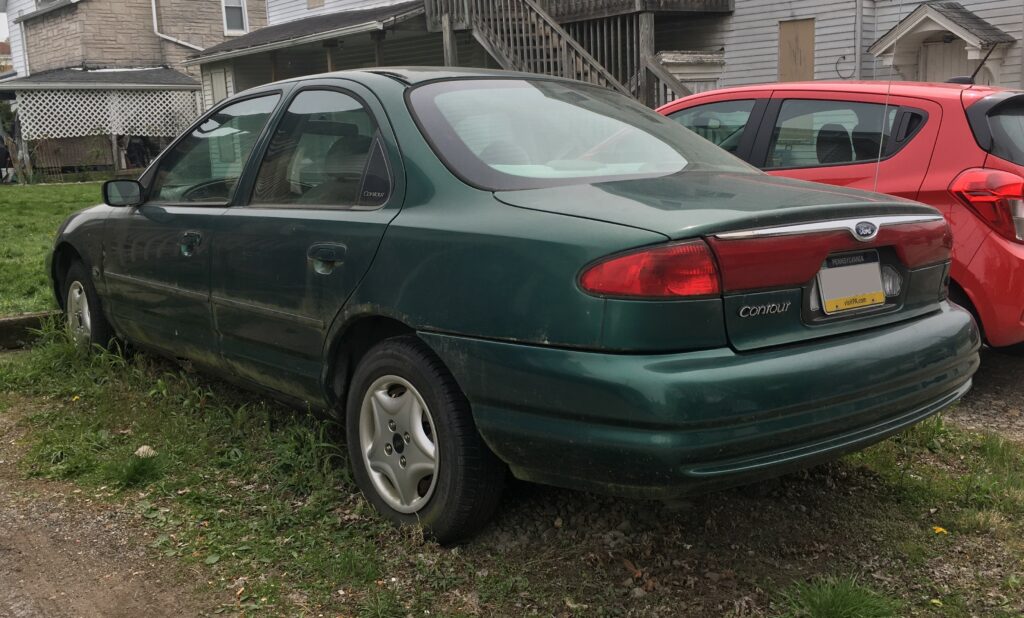
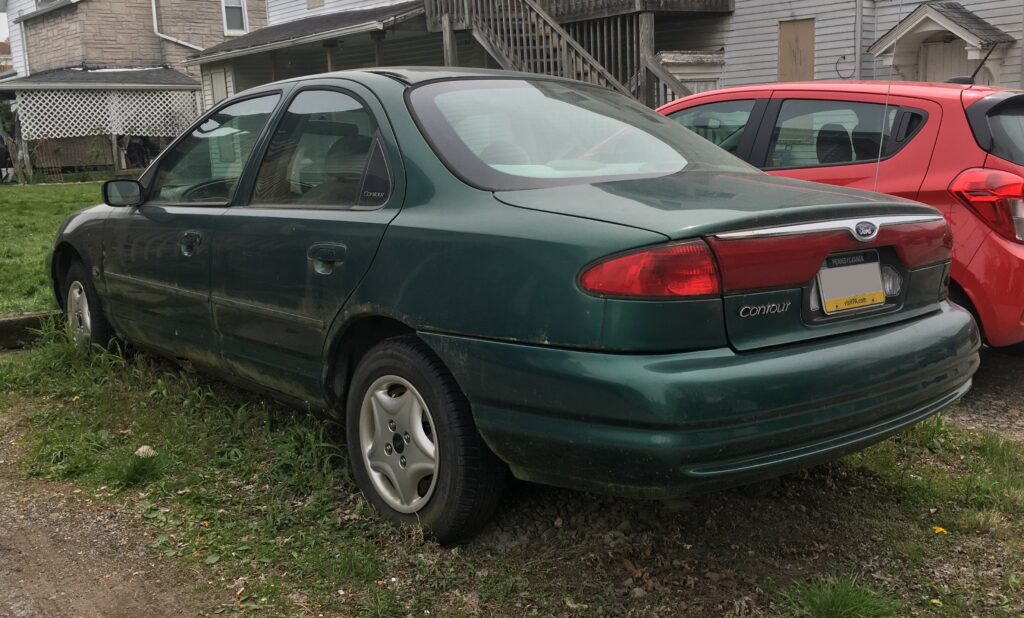
Forest Green Ford Contour. Courtesy of Wikimedia Commons, licensed under CCO 1.0.
In 2016, I bought my first car—a 1997 forest green Ford Contour—for eight hundred bucks cash. Though almost twenty years old, the car had only forty thousand miles on it, which at the time I believed to be an indication of the shape it was in. My main worry was how difficult it would be to find parking in Brooklyn, but when I expressed this, the old Italian woman who sold it to me said, “Oh, honey, don’t worry. This car was blessed by the Pope.” So I gave her the money, and she gave me a comically large car key and a crucifix to hang from the rearview mirror.
It turned out that the car had not been blessed by the Pope. As soon as I drove off, I learned the AC didn’t work. That’s okay, I thought, at least the windows roll down. Minutes later, I was stuck behind a garbage truck in the dense New Jersey traffic in the middle of July. That’s fine, I thought, at least it drives. That night, for reasons I can no longer remember, I christened the car My Sweet Henrietta.
Uglier than the Escape and less reliable than the Focus, the Contour was discontinued in 1999, only four years after it entered the U.S. market. On the rare occasions I could convince my friends to ride with me, I’d joke, “They literally don’t make ’em like they used to.” And they’d say, “This thing is real American muscle,” or “Listen to this baby purr,” or “Does it run on premium or diesel or what?” But our joking would end as soon as we hit the first red light, stop sign, or clot of traffic. Nothing was more terrifying than idling in My Sweet Henrietta, which was missing two engine mounts and shook violently at every standstill.
In hindsight, it seems almost symbolic that I could notice My Sweet Henrietta’s problems only when it was still. On the highway, you couldn’t feel the engine shake, and as long as you were moving, the rolled-down windows kept you cool enough. But every moment spent idling felt like your last, and when parked, the car leaked oil like a sieve—the gaskets had never been replaced, and the entire undercarriage was corroded from road salt, rust, and dirt. In hindsight, it’s almost moving to remember how many frustrated hours I spent circling the congested blocks of Brooklyn, unable to find a parking spot—as if My Sweet Henrietta couldn’t bear the thought of stopping.
Somehow, My Sweet Henrietta ran like this for three years. Somehow, My Sweet Henrietta got me to work most days, and to the better grocery store, and even to Boston once—and twice to Philly. But one morning, as I swung around the edge of Green-Wood Cemetery and began coasting down the hill, the brakes stopped working. Every warning light quickly flashed on the dashboard, then turned abruptly off. There was a loud crack—which I later learned was the engine belt snapping—and then I lost all power steering. I pulled the e-brake and came to an abrupt stop.
On the side of the road next to the graveyard, I called my mechanic—a guy who was honest enough to tell me not to bother fixing my car, but dishonest enough to always let it pass inspection. “Scrap it,” he said. “Maybe you’ll get fifty bucks.” It was summer again, and the tow truck driver joked as he looked under the hood, “No Freon, eh?” and “What century are these spark plugs from?” and “Normally, I’d ask when your last oil change was, but you don’t have any oil left in here to change.” He loaded the car onto his truck bed, strapped it down, and gave me the cash. I left the crucifix hanging from the mirror.
Mathew Weitman’s debut poetry collection, The Campus Novel, is forthcoming with Tupelo Press. His work can be found in Copper Nickel, The Georgia Review, Virginia Quarterly Review, and elsewhere. With July Westhale and Felipe Acevedo Riquelme, he is coediting Rolando Cárdenas: On the Life and Work of a Chilean Master (Pleiades Press, 2026).






Leave a Reply