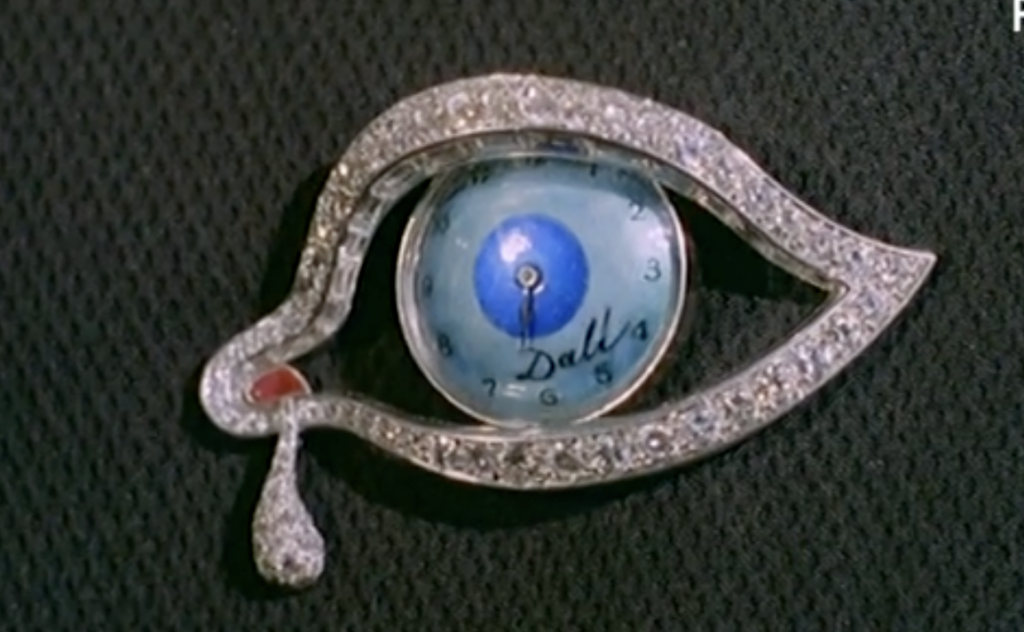
Upon hearing the name of Salvador Dalí, even a total layman in the art world is bound to get visions of melting clocks. Surprisingly, for an artist who showed so much self-marketing savvy, Dalí never brought an actual timepiece in that distinctively, even canonically surreal shape to market. But that hardly stopped Cartier from putting out the Crash, whose distorted shape may have always brought The Persistence of Memory to mind, but whose name hints at the inspiration of a watch smashed up in a car wreck. The Crash came out in swinging-sixties London at its very height, by which time Dalí himself had been designing real jewelry for more than a quarter century.
?si=v8xd7w6Tr3ZQzIIq
You can see a few of Dalí’s jewels in the 1960 British Pathé clip at the top of the post. Unsurprisingly, they occupy a realm apart from, or at least orthogonal to, that of conventional jewelry. Some of them move: Living Flower, for instance, which “opens to reveal stamen and petals paved with diamonds. The mechanism is embedded in malachite from the Congo, which to Dalí represents the unknown, latent forces, while the gold and diamond flowers, known beauty and creativity.”
Angel Cross, by contrast, embodies “the hypoxiological concept of existence — whatever that means.” Certainly, Dalí never claimed to play to the sensibility of the British, though some of them might go in for The Royal Heart, with its “pulsating rubies representing our queen, heart beating constantly for her people, while the nugget gold symbolizes the people sheltering and protecting their ruler.”
The segment’s outtakes feature more footage of these pieces, giving us a longer look at works like The Eye of Time, embedded with a small clock signed by Dalí, and the “leaf-veined hands” he described as “reaching out to the future.” Other of his vivid jewelry designs include the Medusa brooch, completed with a nest of ruby-eyed gold snakes, and a construction that literalizes — and, at the same time, surrealizes — the expression “ruby lips and teeth like pearls.” Realized in collaboration with the well-regarded jewelers Carlos Alemany, Eric Ertman, and Henryk Kaston, and often inspired by his wife and muse Gala, they may be overshadowed by Dalí’s paintings and drawings, but haute couture does pay them occasional homage. What else — indeed, who else — could have inspired the throbbing heart-shaped rhinestone necklace seen on Schiaparelli’s models last summer at Paris Fashion Week?
via Messy Nessy
Related content:
Salvador Dalí’s Surreal Cutlery Set from 1957
The Tarot Card Deck Designed by Salvador Dalí
When Salvador Dalí Created a Surrealist Funhouse at New York World’s Fair (1939)
Captivating Collaboration: Artist Hubert Duprat Uses Insects to Create Golden Sculptures
Based in Seoul, Colin Marshall writes and broadcasts on cities, language, and culture. His projects include the Substack newsletter Books on Cities and the book The Stateless City: a Walk through 21st-Century Los Angeles. Follow him on the social network formerly known as Twitter at @colinmarshall.


Leave a Reply