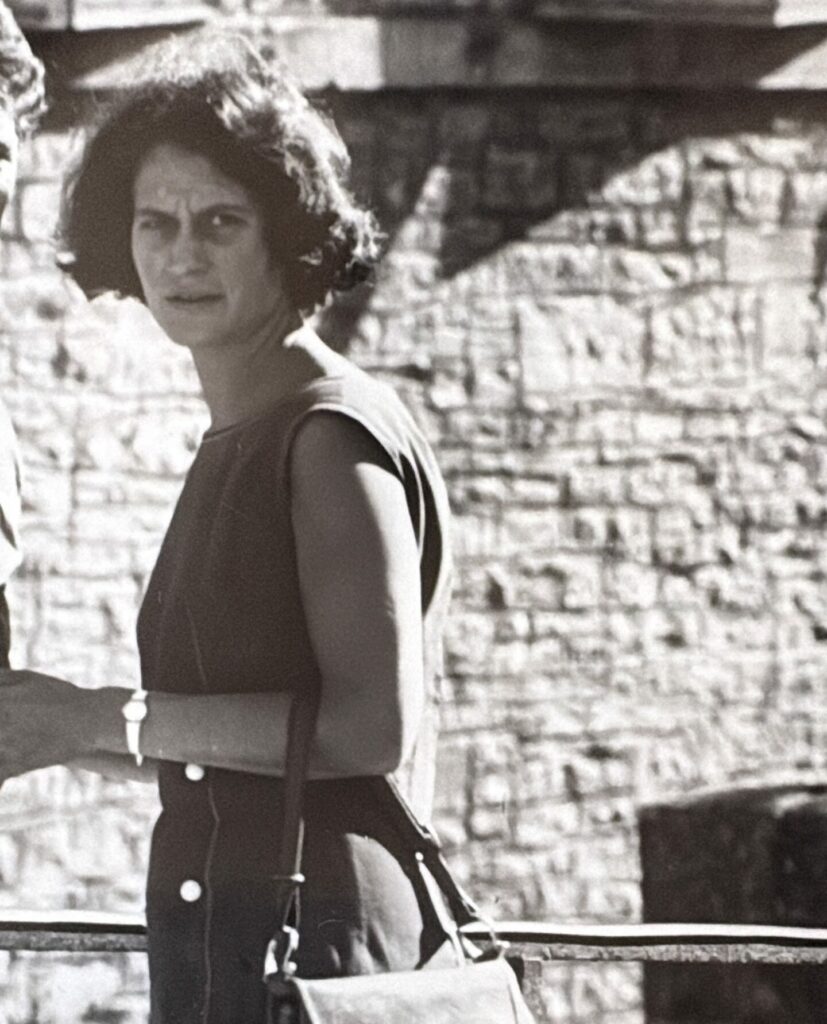
Snapshot of Anya Berger in the late 1960s, taken by Jean Mohr in Ornans, France. Courtesy of Katya Berger.
The following fragment, which dates to 1969, was unearthed in the archives of John and Anya Berger by their daughter, Katya, and John’s biographer, Tom Overton. Read more about its history and their working and romantic relationship here.
When I was twenty-five, I had a short love affair with a pompous man who said things like: “You look marvelous, marvelous, and the most wonderful thing is that, looking at you, one knows that you will be just as desirable in fifteen years … No, thirteen years.” I forgot everything about this person with lightning speed, except this particular remark, and when thirteen years were up, I said to his ghost, “How about it?” And when fifteen years were up, I said, “Now how about that?”
I have always been very healthy, and such changes in my body as have occurred have either been for the better—more covering on the bones, the legs a little finer—or can be accounted for by four pregnancies and four nine-month periods of lactation.
My parents were quite old when I was born, my father fifty and my mother thirty-eight. My mother has been completely shapeless for as long as I can remember, but I am not much like her physically, and emotionally I’m actually her opposite, so there was no identification. My father, whom I loved and admired, I was separated from for seventeen years for reasons connected with world history in those decades: I saw him first as a slim, upright, elegant man of sixty-three, and then again as a haggard, bony relic of eighty, until finally he died senile and shrunken at eighty-five.
The process of aging has been greatly on my mind for a long time, the more so as my husband’s attitude toward it is a complex and contradictory one, which I can’t describe now. I have thought of my own aging many times, formulating in my mind the hope that I will not disappoint myself in this respect: which is to say, that I will know to give age its due, neither concealing nor denying it, nor being coy about it. But my health and general condition have been so good that these thoughts were mostly abstract. I have not been consciously afraid of aging, although I do quite consciously fear that the menopause may make me bad-tempered and self-pitying, in the way I tend to be before menstruation, but for an incomparably longer period.
Weakening eyesight is irreversible and incurable. Thanks to modern optics you can live perfectly comfortably with it, and if you have contact lenses you can even completely disguise it. But you can never have strong young eyes again.
I went into the chemist’s shop, the biggest and smartest in the town where I live. On the ground floor there is a medicine counter and a counter for toiletries, and down the center aisle of the shop there are several booths, each of which sells cosmetic of one particular brand: Elizabeth Arden, Dior, Germaine Monteil, and the rest. Recently they have expanded the shop and added a book stall, a records counter, and a boutique for scarves, bags, and watch straps. The shop has an expensive smell and is mostly associated with buying small expensive luxuries, like bath oil, rather than with medicines; for these, you go to your local chemists. Upstairs is for maternity clothes, baby articles and the opticians.
I was walking quickly and lightly, a busy woman with a free afternoon in town. I went straight up to the woman at the counter and said: “I think I need some reading glasses and I’m not sure how to go about getting them; perhaps you can advise me.” The woman wore glasses and had silvery gray hair but was not old. (My hair is brown and quite curly.) She smiled and said: “That’s no problem; we test your eyes free of charge, and if you need glasses, we shall supply them. Please take a seat for a moment.” I did not feel like sitting down but walked around the department instead. There were three tables with chairs on both sides and a lot of showcases with different spectacle frames in them which you could pick up and try on. One wall was entirely covered with barometers of different designs. There were several photographs of people wearing glasses, not as ugly as many others you see. I picked up several frames and tried them on. There were mirrors everywhere, and a three-sided mirror on every table. My husband had said: “Perhaps I ought to come with you to choose the frames. For goodness’ sake, don’t buy any that try to make you look as if you weren’t wearing glasses; they’re awful.” I had laughed and said: “You won’t often see me wearing them; they’re only reading glasses after all.”
The wait was very short, and presently a young man in a white coat invited me to sit opposite him at one of the tables. He took down my name and address and measured the width of my head just above the ears. Then he said, “Have you any ideas about frames?” I said, “I don’t want anything that looks as if I was pretending I didn’t have glasses on, you know what I mean?” He said, “Oh, quite, those are right out of fashion now; you won’t find many here. Let’s try a few pairs on, shall we?” I let him give me a few, but he wasn’t very interested and they were no good, so I got up and showed him a few pairs in the showcase which I had thought might be good, and after a few more tries we found bold steel frames, rather high fitting, which looked all right. The light was harsh, and the three-sided mirror showed up the lines in my face. He said, “You’ll only be wanting them for reading, won’t you?” and I answered “Oh, yes, only for that.”
Then another man came and asked me to go along to be tested. He also wore a white lab coat but was older—thirty-five or so—and had a lined face, quite handsome. He took me into a small side room like a surgery and made me sit down in an armchair. The first thing he said was, “You know, it’s perfectly normal to need glasses for reading. How old are you? We’re all getting younger all the time,” he said, and he smiled at me.
First, he made me look at some circles on a chart on the wall and tell him where the circle didn’t close up . I was able to do this without any difficulty, even with the smallest circle. “Very good,” he said, and he produced a piece of cardboard with ordinary print of various sizes on it. “Hold this at a comfortable distance,” he said. The comfortable distance for the smallest print proved to be about four inches farther than normal. “Ah,” he said. “Now how about this.” He hooked a thing around my head which was like the device we used to have when I was a child for looking at lantern slides—not diapositives because those didn’t exist when I was a child, but ordinary tinted lantern slides—a device like a pair of glasses with a forward extension to which a second pair of glasses is attached about three inches from your face. He slipped two lenses into the extension, and the small print suddenly became perfectly clear and sharp. “Now hold the card at a comfortable distance again, please. Ah. Very good.” I was so pleased with the lovely clarity of the print that I read the message out loud. It was something about how important it is to have the right lenses in your spectacles. “These are the right lenses for you,” he said. “I am not giving you very strong ones because this is the first time you are wearing glasses. In fourteen months to two years, you are likely going to require slightly stronger ones. Then you must come back to us straight away. Of course you will not have to get new frames. Just the lenses.”
“Would you mind taking the lenses out just for a moment and let me read the card without them?” I asked. “Of course.” I found that I could hardly read the small print at all, at any distance, after the intense pleasure of seeing it so clearly.
Then we went back into the shop and he made me try on the frames I had chosen and said, “You have made an excellent choice, of course these are only reading glasses and you won’t be wearing them all the time.” “Yes,” I said. Then I added, slightly raising my voice, “But you know, I’m a translator and I read small print practically all the time.” “Ah,” he said, “and do you translate from many languages?” “No, not many,” I said, “only two or three.” “You can pick up your glasses tomorrow afternoon at three o’clock,” he said, and then he told me the price. It was much less than I had imagined.
As I went out, I looked back at the first young man, who was by this time attending to another lady customer. As I looked at him, I noticed that he was looking at my legs. I said goodbye and smiled, and as I did so he looked up at my face and smiled too.
Before leaving the shop, I wanted to stop at the book counter to see if by any chance they had my husband’s latest book. He would have been amused if I could have told him they did. But I found that my legs were trembling just above the knees. I went out quickly and walked fifty yards to a coffee shop and sat down.
Aging is not the only process I think of, hoping that I shall not disappoint myself. Fear or apprehension of the future always seems to take this egocentric form with me: It is not the actual event that I fear but my reaction in the face of it. If I am involved in an accident, will I panic? If I am brought bad news about someone I love, will my grief be merely self-pitying? If I am arrested, perhaps at a demonstration, will I behave courageously? If the cause I believe in is proved faulty, and loyalty has to be weighed against the truth, will I make the right choice?
These eventualities are not all certain to occur, as aging is, but some of them are quite likely to occur to everyone in the course of a lifetime, while others are particularly likely to occur to a dissenting person, and I am more or less permanently braced against them.
I don’t believe my knees were trembling as I left the chemist’s shop because I was suddenly so horrified by the irreversible process of my aging. It was because something I had thought of so often was happening now. At last. Relief more than fear. Excitement because the challenge was real and waiting to be taken up. Reality instead of the anticipation of reality.
The important thing that happened during the visit to the optician was when the lens was slipped into the eye-testing device. The new way of seeing suddenly became the normal one and the old way—quite tolerable until then—became abnormal and indeed impossible.
Of course, the lens is a manufactured commercial product made to make things more pleasant for millions of aging people who can afford to have their vision corrected. No such product exists to assist accident victims, bereaved people, arrested demonstrators, or revolutionaries assailed by reasonable doubt. Yet I now imagine that the very fact of reality replacing anticipated reality, of the challenge being there waiting to be taken up, may in a sense be parallel to the experience with the lens. It happens, and instantly everything that existed previously, and which until then you considered normal, becomes abnormal and impossible. The important thing, which incidentally gave me strength to admit that I would be wearing the glasses all day long, was not the efficiency of the manufactured lens. It was that now I know that my eyesight was really a lot weaker than it had been, too weak to go on reading without glasses. I was no longer playing at being a young woman who might possibly need her vision slightly corrected. In this respect at least, I had suddenly become my full age and joined all the other people of my age, and if my knees trembled, it wasn’t because I hated it so, but because I was excited by it.
Anya Berger (1923–2018) worked as a translator for the United Nations for forty years. She was also a book reviewer, refugee, and wife of the art critic and novelist John Berger. A two-volume collection of her life writing is forthcoming, edited by Katya Berger, Mona Chollet, and Emily Foister, drawn from the private family archive; it will include short stories, memoir, poetry, diaries, letters, telegrams, and doodles.





Leave a Reply