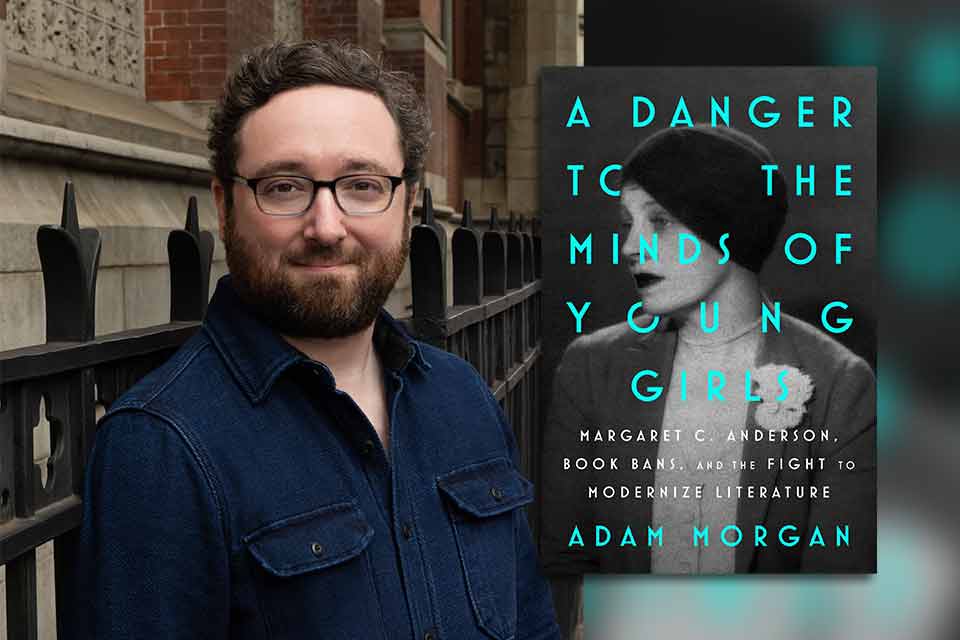

Adam Morgan’s A Danger to the Minds of Young Girls: Margaret C. Anderson, Book Bans, and the Fight to Modernize Literature (Atria/One Signal, 2025) reconstructs the remarkable life and career of Margaret Anderson (1886–1973), the pioneering publisher of the Little Review who found herself at the center of America’s first major literary obscenity trial in 1921. Morgan traces Anderson’s journey from her early days establishing the avant-garde magazine in Chicago through her relocation to New York and eventually Paris, chronicling how she transformed the Little Review into a crucial platform for modernist writers including T. S. Eliot, Ezra Pound, William Butler Yeats, and Djuna Barnes. The biography culminates with Anderson’s prosecution for serializing James Joyce’s Ulysses, a legal battle that branded her “a danger to the minds of young girls” and positioned her as a scapegoat for conservative forces resistant to cultural modernization.
Morgan argues that Anderson’s story represents more than individual courage; it exemplifies the broader struggle between progressive artistic expression and reactionary censorship that continues to shape American cultural debates. He presents Anderson as both a literary tastemaker who recognized genius before the establishment and a political activist who used her magazine to advocate for women’s suffrage, birth control access, and LGBTQ rights. Through meticulous research drawing on Anderson’s correspondence, legal records, and contemporary publications, Morgan positions the Little Review as a woman-led enterprise that fundamentally altered American literary culture by providing a platform for experimental writing that traditional publishers deemed too risky or controversial.
Morgan’s central thesis—that Anderson deserves recognition as a foundational figure in American literary modernism—is convincingly supported by his extensive archival research. His documentation of Anderson’s editorial correspondence reveals her sophisticated literary judgment and her willingness to champion difficult works that other publishers rejected. The author’s analysis of the obscenity trial is particularly strong, drawing on court transcripts to demonstrate how legal persecution of Anderson reflected broader anxieties about changing social mores rather than genuine concerns about literary merit. Morgan effectively contextualizes Anderson’s struggle within the larger pattern of government censorship targeting progressive voices, making compelling connections between her era’s culture wars and contemporary debates about artistic freedom.
Morgan effectively contextualizes Anderson’s struggle within the larger pattern of government censorship targeting progressive voices, making compelling connections between her era’s culture wars and contemporary debates about artistic freedom.
However, Morgan’s obvious admiration for his subject occasionally undermines critical analysis. While his passion brings Anderson’s story to life, it sometimes prevents deeper examination of her limitations and contradictions. For instance, Morgan gives insufficient attention to how Anderson’s privileged background as a white, educated woman from a middle-class family shaped both her opportunities and her blind spots. Her ability to operate the Little Review despite chronic financial losses depended on personal connections and cultural capital not available to many other potential publishers, yet Morgan treats her achievements as though they emerged from pure determination rather than structural advantages.
The book’s organizational structure effectively builds narrative tension toward the obscenity trial, but Morgan’s chronological approach sometimes obscures broader thematic connections. A more analytical framework might have better illuminated how Anderson’s various causes—literary modernism, women’s rights, sexual liberation—interconnected with her editorial vision. Additionally, while Morgan celebrates Anderson’s role in fostering a literary counterculture, he provides limited analysis of how gender dynamics shaped both her successes and the specific nature of the opposition she faced.
Morgan’s prose is engaging and accessible, though it occasionally lapses into hyperbolic language that diminishes his scholarly credibility. Describing Anderson as an “unsung heroine” and “fearless agitator” reveals his advocacy rather than maintaining analytical distance. The biography would benefit from a more measured assessment of Anderson’s actual influence compared to other contemporary publishers and editors who faced similar challenges.
A Danger to the Minds of Young Girls succeeds admirably in rescuing Margaret C. Anderson from historical obscurity and establishing her significance within American literary culture. As someone fascinated by Red Scare–era politics and literary censorship, I found Morgan’s detailed account of the legal proceedings particularly compelling. The parallels he draws between Anderson’s prosecution and contemporary attempts to restrict artistic expression feel urgent and relevant. This biography served as my first substantial exposure to Anderson’s life and work, and Morgan’s research has convinced me that her contributions to American modernism have been seriously undervalued by literary historians.
The book’s greatest strength lies in demonstrating how cultural progress often depends on individuals willing to accept personal costs for challenging established boundaries. Anderson’s story illuminates the often-hidden networks of support that enable avant-garde movements, while her legal troubles remind us that artistic freedom remains perpetually contested rather than permanently secured. Morgan’s biography joins works like Brenda Wineapple’s The Impeachers and Beverly Gage’s G-Man in excavating forgotten episodes that illuminate persistent tensions in American cultural and political life. While the book’s hagiographic tendencies occasionally frustrated me, its core achievement—restoring Anderson to her rightful place in the story of American literary modernism—makes it essential reading for anyone interested in how literature and politics intersect during periods of rapid social change.
Susanville, California


Leave a Reply