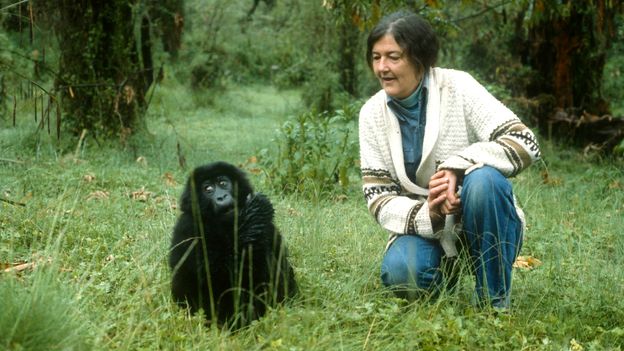
Fossey’s early research demanded patience. To gain the gorillas’ trust, she began to mimic their behaviour. She told the BBC’s Woman’s Hour in 1984: “I’m an inhibited person, and I felt that the gorillas were somewhat inhibited as well. So I imitated their natural, normal behaviour like feeding, munching on celery stalks or scratching myself.” She had to learn her lessons quickly. “I made a mistake chest-beating in the beginning… because by chest-beating I was telling the gorillas I was alarmed, as they were telling me they were alarmed when they chest-beat.” Instead, she learned to imitate their belch-like “contentment sounds”. Demonstrating how she would make a noise like a gorilla, she added: “Wouldn’t it be nice if humans could go through life belch vocalising instead of arguing?”
Fossey learned to communicate with gorillas by never standing taller than them: “When I approach a group, I do approach it knuckle-walking, as gorillas walk, so that I will be at their level. I don’t think it’s quite fair to them. After all, I am 6ft tall as well. But to be standing up, they don’t know if you’re going to attack or run after them or what.” After years of gaining the confidence of the gorillas, she had habituated them to her presence, and they allowed her to sit alongside them without any concern. She had destroyed the myth of gorillas as being violent creatures.
Attenborough’s encounter with her
In 1979, the wider world witnessed Fossey’s habituation work in practice via David Attenborough’s groundbreaking BBC natural history series Life on Earth. At the time, mountain gorillas were on the verge of extinction. His encounter with a gorilla family has since become one of the most famous sequences in television history. As he sits surrounded by these “gentle and placid creatures”, in a soft tone he says: “There is more meaning and mutual understanding in exchanging a glance with a gorilla than any other animal I know… We see the world in the same way that they do.” He adds: “If ever there was a possibility of escaping the human condition and living imaginatively in another creature’s world, it must be with the gorilla.”
In the retrospective 2007 BBC documentary Gorillas Revisited with Sir David Attenborough, he admitted that he initially thought the plan to film the animals to demonstrate their evolutionary advantage of opposable thumbs (allowing them to grip onto objects, including branches, securely) was too ambitious. He said: “Mountain gorillas live 3,000 metres high, up in the Virunga Volcanoes, and are notoriously difficult to approach. Getting to them would mean carrying all our film equipment up 45-degree slopes through thick jungle. And most problematical of all, there was no way that we would be able to film them without the help of Dian Fossey – the only person in the world who was studying them in the wild.” Attenborough said that from what he’d heard, there was no way she would allow a television crew to join her. Life on Earth director John Sparks wrote her a persuasive letter, but “it surprised us all that she wrote back a very nice letter saying, ‘You’re welcome’”.



Leave a Reply