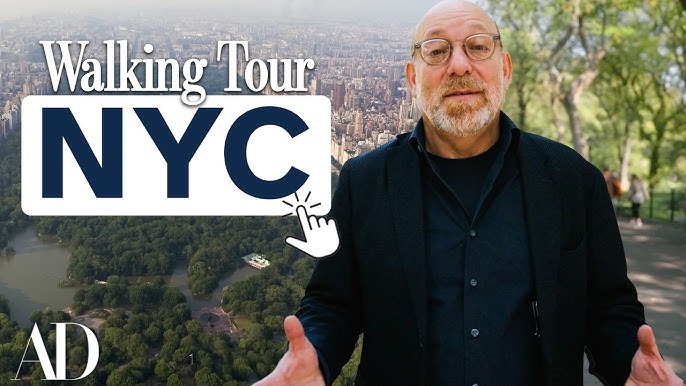
New York isn’t the oldest city in the United States of America, and it certainly isn’t the newest. But it is, quite possibly, the American city where more layers of history coexist than any other, a quality that manifests most vividly in its built environment. Even the most casual tourist can sense the sheer variety of time periods embodied in the buildings around them on, say, a stroll down Broadway — one of the streets featured in the ten-part walking tour compiled in the new Architectural Digest video above. As a whole, it offers a two-hour journey through the city beginning in Central Park and ending on Wall Street.
In between come on-foot examinations of everything from the fin-de-siècle “apartment hotels” of the Upper West Side to the recently built “super-tall” residential towers of West 57th Street to the developments atop the buried Grand Central Station to the disused industrial railway now known — and imitated around the world — as a linear park called the High Line.
Tend though longtime New Yorkers may to regard each part of the city as more or less a nation unto itself, a perspective with a bit more distance reveals signs of the never-ending social, economic, and aesthetic exchange between them: an important factor in how the use of and role played by even the city’s most august structures has been subject to change after unanticipated change.
Helping us to understand all this are architects Michael Wyetzner and Nick Potts, both professionally well placed to explain both the big picture of New York’s evolution and the significance of the various oddities and eccentricities on its streets. Even an architectural layman would take impressed notice while passing, say, the mansions once inhabited by Alexander Hamilton and Aaron Burr; the jagged bunker that has housed the Whitney Museum of American Art, the Met Breuer, and Frick Madison; the impossibly skinny-looking skyscrapers of the so-called “Billionaire’s Row”; or the Dakota, John Lennon’s final residence. But to learn what such buildings have to tell us about the history and nature of New York, we must look at them, as another famous rock star once sang, thru’ these architects’ eyes.
Related Content:
The Lost Neighborhood Buried Under New York City’s Central Park
A Whirlwind Architectural Tour of the New York Public Library — “Hidden Details” and All
A Walking Tour of Los Angeles Architecture: From Art Deco to California Bungalow
A 5‑Hour Walking Tour of Paris and Its Famous Streets, Monuments & Parks
Based in Seoul, Colin Marshall writes and broadcasts on cities, language, and culture. His projects include the Substack newsletter Books on Cities and the book The Stateless City: a Walk through 21st-Century Los Angeles. Follow him on the social network formerly known as Twitter at @colinmarshall.





Leave a Reply