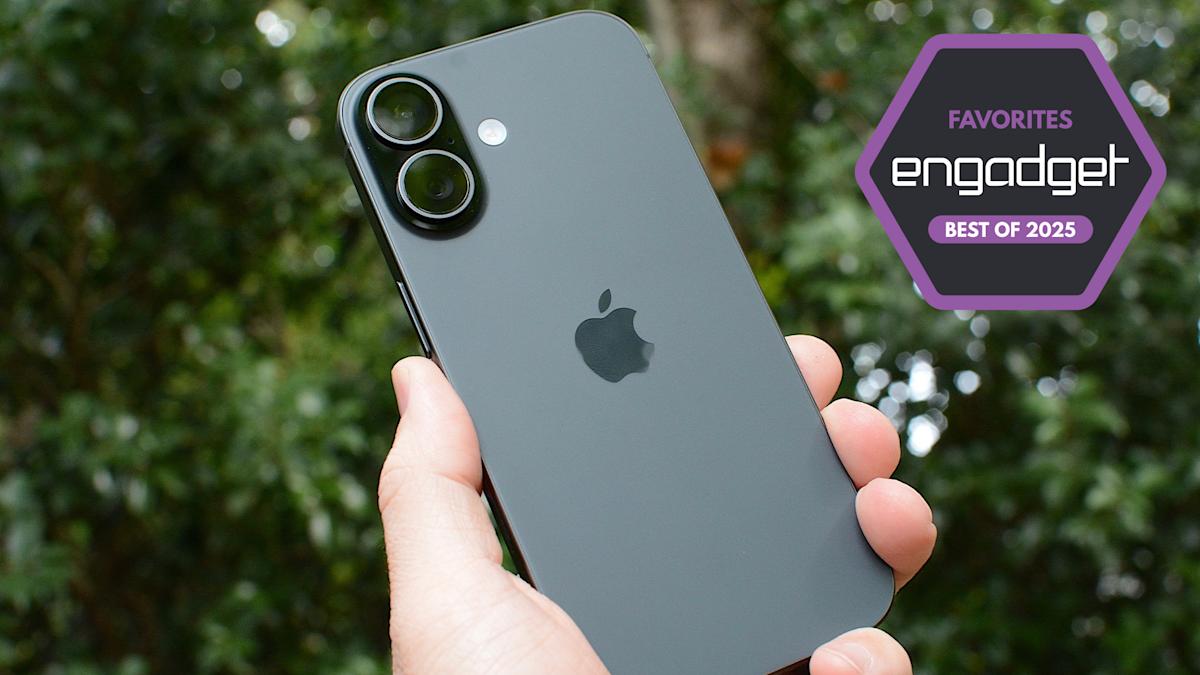
Original release date: February 28, 2025 | Storage capacity: 128GB, 256GB, 512GB | Screen size: 6.1 inches | Features: A18 chip (4-core GPU), 60Hz display, Aluminum frame, USB-C port (USB 2), Action button, 7.5W Qi wireless charging, Apple Intelligence | Cameras: 48MP rear, 12MP front | Color options: White, Black | Dimensions: 5.78 x 2.82 x 0.31 inches | Weight: 5.88 ounces
Read our full iPhone 16e review
Here’s the reality: There’s no such thing as a true budget iPhone in 2025. The $429 iPhone SE was the closest thing Apple had to a value-oriented model coming into the year, but it was officially discontinued in February, and its severely outdated design made it difficult to recommend long before that. The new iPhone 16e is the SE’s ostensible replacement, but it costs $599, well above what anyone could call “affordable” when there are so many genuinely decent Android phones that sell for hundreds of dollars less.
So when we recommend the iPhone 16e in this spot, think of it less like a budget pick and more like “the cheapest competent iPhone you can reliably buy.” It’s easy to see how it could be better, but it still gets you most of what makes the iPhone experience worthwhile.
It looks and feels much more substantial than the old iPhone SE, with a larger and more vivid 6.1-inch OLED display, cleaner lines and flat aluminum edges. Its A18 chip is nearly the same as the one in 2024’s iPhone 16, just with one fewer GPU core; either way, it’s powerful enough to run Apple Intelligence and most games fine. Its battery life is decent, with a video playback rating of 26 hours, though it’s a bit behind each model in the iPhone 17 family. It has a USB-C port, Face ID and the programmable Action button. Most importantly, it’s the least expensive route into iMessage, Apple Pay, FaceTime, AirPlay and all the other iOS perks locked in Apple’s walled garden, for better or worse.
That said, the iPhone 17 still brings meaningful upgrades for $200 more. It has a better camera setup, for one, with a second, 48MP ultrawide lens and a larger main sensor with better image stabilization. The 16e’s single-camera system is still perfectly fine for most situations, but night shots look softer, portraits are a bit blurrier and there’s no macro mode.
Annoyingly, the iPhone 16e also lacks MagSafe, locking it out of a host of useful accessories, and it’s limited to slow 7.5W wireless charging. There’s no ultra-wideband chip to more precisely locate AirTags, and the standard iPhone 17’s display is now a marked improvement thanks to its 120Hz refresh rate, higher peak brightness and always-on functionality. That screen also has the Dynamic Island, which makes it easier to check timers, Uber ETAs, sports scores and the like at a glance. The 16e, by comparison, has the static “notch” from older iPhones. The 17 is also available in more colors, whereas the 16e only comes in a more basic black or white. And it starts with half the storage space.
In many ways, the iPhone 16e feels like it was designed backwards to make the base model look like a better value. Nevertheless, if you can stretch your budget to get the iPhone 17, it’s worth doing so.
Really, bargain hunters should look to the refurbished market for discounts on older iPhones first. If you can find an iPhone 16 (or even an iPhone 15) from a reputable seller for $100+ less than the 16e, that’d be ideal, since those include many of the 16e’s missing features (120Hz display aside) and anything older won’t have a USB-C port. If you see an iPhone 16 Pro or iPhone 15 Pro around the same price or less, it’s no contest — those are better than the 16e pretty much across the board.
But even a refurbished 15 is unlikely to be that cheap, and older iPhones are more likely to lose update support sooner. Still, that might not matter so much if you just want an Apple phone for basic iOS things and can find an acceptable price-to-storage ratio. Taking advantage of trade-in deals or, to a lesser extent, monthly installment plans that lower upfront costs seems especially prudent these days as well.
As it stands now, the lack of a competitive budget model in the iPhone lineup is disappointing, and it appears that won’t change anytime soon. Apple will be Apple. But if you just want to walk into an Apple store and buy an iPhone that works, the 16e is fine enough, even if it’s not a slam-dunk value.



Leave a Reply