HOUSTON — On April 5, 1968, the day after Martin Luther King Jr. was assassinated, Joe Overstreet started a brand new portray. The piece that will turn into “Justice, Religion, Hope, and Peace” (1968) takes its title from King’s impassioned phrases, which Overstreet interprets as colliding angles, target-like rings, and diamond-shaped central panels, diverging from the oblong image aircraft to kind a type of protect. Spanning some 7.5 by 16 ft, the huge, four-paneled work emits an explosive sense of strain and upheaval that displays the second of its creation.
Two years later, the portray’s two central panels have been despatched from Overstreet’s New York studio to Houston for a gaggle present organized by Dominique and John de Menil, socially acutely aware artwork patrons and future founders of the Menil Assortment. The couple invited Overstreet to Houston once more in 1972 for 2 solo exhibitions and bought a variety of his works. However the two panels from his 1968 portray have been by no means proven within the metropolis and remained in storage till the artist requested for his or her return practically 10 years later. In his alternate with Dominique (John de Menil died in 1973), Overstreet wrote that he’d “like very a lot to indicate my work in Houston once more sometime.” That day has lastly come.

Joe Overstreeet: Taking Flight on the Menil Assortment shines a long-overdue highlight on an astonishingly modern artist who explored the Black expertise in the US via abstraction. All 4 panels of “Justice, Religion, Hope, and Peace” have been reunited for the exhibition. Thoughtfully curated by Natalie Dupêcher, the present additionally options items from three of the artist’s main sequence. Visually, the works’ good colours and creative varieties are breathtaking, however a better look reveals deeper messages concerning the sophisticated political world wherein the artist lived.
Born in rural Conehatta, Mississippi, in 1933, Overstreet and his household left the South within the early Forties and finally settled in Berkeley, California. The artist joined the US Service provider Marine earlier than establishing his first studio in San Francisco, the place Beat poetry, jazz music, and the artist Sargent Johnson have been formative influences. A transfer to the Higher West Facet of New York Metropolis in 1958 launched him to an older era of painters like Willem de Kooning and Franz Kline, and in 1960, Overstreet joined Ellsworth Ausby, Solar Ra, and different members of the colourful Black arts and music scene on town’s Decrease East Facet.

By the mid-Sixties, Overstreet was a distinguished determine within the Black Arts Motion. He created his work “with a message concerning the time, about Black folks and about this nation,” he later said (quoted within the exhibition catalog). A basic a part of his mission was to interrupt freed from the flat, rectangular image aircraft that had characterised a lot of Western artwork historical past; he needed to forge a substitute for the Eurocentric view of portray that continued to dominate American artwork. In 1967, he started constructing elaborate formed canvases, like these of “Justice, Religion, Hope, and Peace,” and deserted stretchers completely simply three years later.
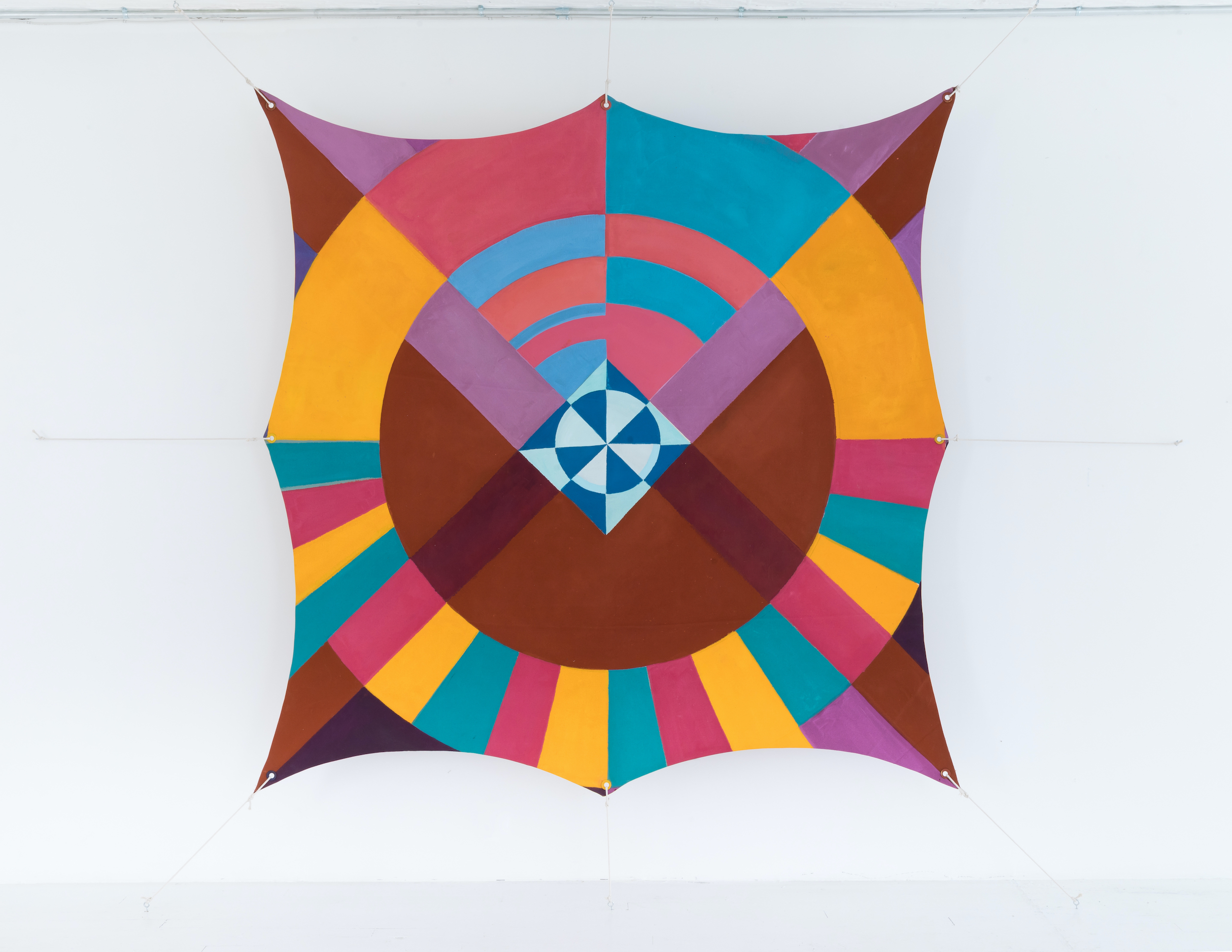
Overstreet is probably greatest identified for his Flight Patterns works, composed of unstretched painted and stained canvas suspended mid-air by ropes anchored to the gallery partitions, flooring, and ceiling. The dazzling, seemingly airborne varieties resemble kites, sails, flags, or tents that enliven the area with their radiant coloration. However rigorously chosen titles like “We Got here from There to Get Right here” (1970) and noose-like knots — an intentional reference to the historical past of race-based lynchings in the US — allude to extra pertinent points in American society. In each bit, a number of factors of pressure, brought on by binding and pulling, mirror the intense pressure on Overstreet and lots of different activists and artists because the Civil Rights motion, Vietnam Struggle, and political unrest within the US intersected within the Sixties and ’70s.

“The stress is actually key to the remark he’s making about life in the US within the early Seventies with the Vietnam Struggle and the Civil Rights and Black Energy actions,” Dupêcher informed Hyperallergic on a current tour of the exhibition. Overstreet, who died in 2019, indicated that his Flight Patterns could possibly be positioned in another way in future installations, in order that they alter barely with every exhibition. However he stipulated that they need to all the time be stretched tight, with at the least one noose tied to each piece.
The ultimate group of works on view emerged from Overstreet’s pivotal journey to Senegal in 1992. Visiting the nation for a gaggle exhibition and biennial, he was impressed by its vibrant gentle and glimmering, dusty environment. However the artist was was particularly impacted by Gorée Island, a serious outpost of the transatlantic slave commerce for over 300 years. A visit to a cell block often called the Maison des esclaves, or Home of Slaves, prompted him to start work on a brand new sequence of wall-sized work shortly after his return to New York.
Overstreet’s Senegal items immerse the viewer in lush layers of pastel oil paint and beeswax that give off a quiet, virtually impressionistic glow. The works are disarmingly lovely, and a few viewers might solely expertise them as such — titles reference Gorée subtly, and the Menil doesn’t embrace didactic wall texts in its galleries. However, like Flight Patterns, these works make the most of the pleasures of paint and coloration to answer deep ache. Every 10-by-12-foot portray is modeled on the dimensions of the once-crowded cells at Gorée, and feathery, repeated marks recommend footsteps pacing throughout the canvases. These works haven’t been displayed publicly for practically 30 years, so seeing them — together with a lot of Overstreet’s advanced and beautiful artwork — is a uncommon and profound privilege.


Joe Overstreeet: Taking Flight continues at the Menil Assortment (1533 Sul Ross Avenue, Houston, Texas) via July 13. The exhibition was curated by Natalie Dupêcher in collaboration with the artist’s property.
Editor’s Notice: Hyperallergic’s normal picture coverage is to run images taken by our reviewers to authentically signify their expertise. An exception was made on this evaluate because of the venue’s restrictions on pictures.





Leave a Reply