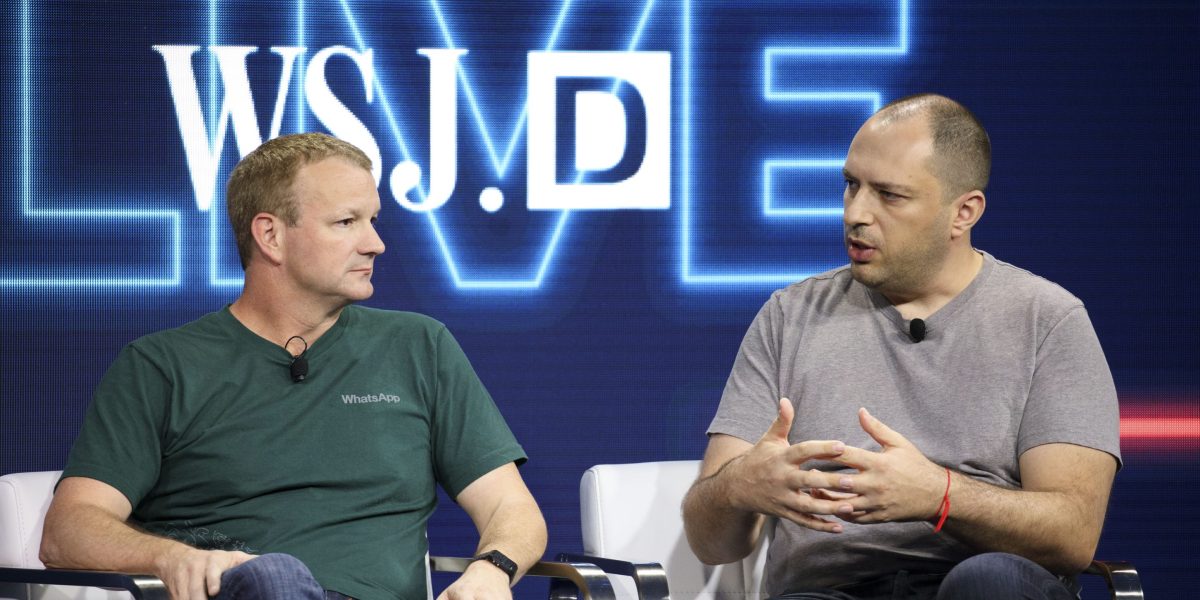

- The cofounders of WhatsApp resisted adverts in the app for years, together with after the corporate was acquired by Meta for $22 billion in 2014. Brian Acton and Jan Koum left the corporate in 2017 and 2018, respectively, and on Monday Meta launched adverts within the “Standing” function in addition to sponsored Channels within the the “Updates” tab of WhatsApp.
WhatsApp cofounders Jan Koum and Brian Acton by no means wished to incorporate adverts of their messaging platform, however new proprietor Meta moved ahead Monday with a plan to do exactly that.
Fb and Instagram’s father or mother firm, which purchased WhatsApp in 2014, stated Monday it might introduce adverts within the app’s “Updates” tab, which the corporate stated counts on 1.5 billion customers day by day. The “Standing” function, which exhibits disappearing pictures or movies, will now embrace adverts very like Instagram “Tales” and advertisers also can now pay to spice up their very own WhatsApp channels. Individuals and corporations that run their very own channels will even be capable of promote subscriptions to their content material, the corporate stated in a weblog publish.
The brand new advert options run counter to WhatsApp’s cofounders’ imaginative and prescient. When Koum and Acton first launched the app in 2009 after quitting their jobs at Yahoo! the pair actively resisted including promoting following earlier dangerous experiences. As a substitute, they charged customers $1 per yr for utilizing the service after a free yr.
Former CEO Koum reportedly saved a notice from Acton on his desk to remind him of the corporate’s mission, in response to Sequoia Capital accomplice Jim Goetz.
“Jan retains a notice from Brian taped to his desk that reads ‘No Advertisements! No Video games! No Gimmicks!’ It serves as a day by day reminder of their dedication to remain centered on constructing a pure messaging expertise,” Goetz wrote in a 2014 weblog publish.
When Koum and Acton bought the corporate to Meta (then Fb) for $22 billion in 2014, Meta assured them it might hold WhatsApp ad-free and the pair wouldn’t must compromise their rules, Goetz wrote within the weblog publish. In their very own weblog publish, the cofounders additionally promised “completely no adverts interrupting your communication,” the Washington Submit reported in 2018.
Nonetheless, WhatsApp’s cofounders reportedly later clashed with Meta’s management on the monetization of WhatsApp. Each Acton and Koum left WhatsApp, in 2017 and 2018, respectively, after an extended battle over stress for WhatsApp to share extra information with Fb in addition to the push by Meta to incorporate adverts in WhatsApp.
In 2019, Acton stated in an interview with Forbes that Meta’s plans to incorporate adverts in WhatsApp’s Standing function broke a social compact with the app’s customers. “Focused promoting is what makes me sad,” he stated.
When Acton proposed a substitute for promoting on WhatsApp, which included charging customers for messages despatched after a cutoff of free messages, Sheryl Sandberg, then the corporate’s chief working officer, shot him down as a result of it wouldn’t scale, Acton stated.
“I known as her out one time,” Acton advised Forbes. “I used to be like, ‘No, you don’t imply that it gained’t scale. You imply it gained’t make as a lot cash as . . . ,’ and she or he sort of hemmed and hawed a little bit. And we moved on. I feel I made my level. . . . They’re businesspeople, they’re good businesspeople. They only characterize a set of enterprise practices, rules and ethics, and insurance policies that I don’t essentially agree with.”
A spokesperson for Meta stated in an announcement to Fortune that the corporate has been speaking about incorporating adverts into WhatsApp for years, and added that the brand new advert options gained’t interrupt customers’ chats.
“We expect this displays how folks wish to use WhatsApp and means should you simply you WhatsApp to ship private messages to family and friends, nothing adjustments,” the spokesperson stated.
This story was initially featured on Fortune.com






Leave a Reply