The Soviet Union’s repressive state censorship went to absurd lengths to control what its citizens read, viewed, and listened to, such as the almost comical removal of purged former comrades from photographs during Stalin’s reign. When it came to aesthetics, Stalinism mostly purged more avant-garde tendencies from the arts and literature in favor of didactic Socialist Realism. Even during the relatively loose period of the Khrushchev/Brezhnev Thaw in the 60s, several artists were subject to “severe censorship” by the Party, writes Keti Chukhrov at Red Thread, for their “’abuse’ of modernist, abstract and formalist methods.”
But one oft-experimental art form thrived throughout the existence of the Soviet Union and its varying degrees of state control: animation. “Despite censorship and pressure from the Communist government to adhere to certain Socialist ideals,” writes Polly Dela Rosa in a short history, “Russian animation is incredibly diverse and eloquent.”
Many animated Soviet films were expressly made for propaganda purposes—such as the very first Soviet animation, Dziga Vertov’s Soviet Toys, below, from 1924. But even these display a range of technical virtuosity combined with daring stylistic experiments, as you can see in this io9 compilation. Animated films also served “as a powerful tool for entertainment,” notes film scholar Birgit Beumers, with animators, “largely trained as designers and illustrators… drawn upon to compete with the Disney output.”
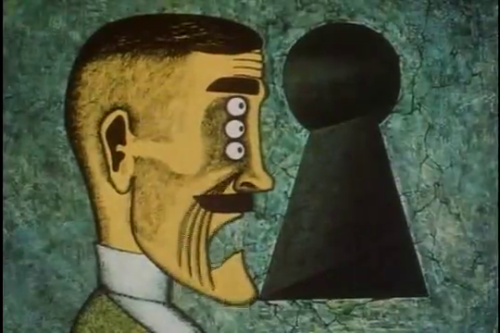
Throughout the 20th century, a wide range of films made it past the censors and reached large audiences on cinema and television screens, including many based on Western literature. All of them did so, in fact, but one, the only animated film in Soviet history to face a ban: Andrei Khrzhanovsky’s The Glass Harmonica, at the top, a 1968 “satire on bureaucracy.” At the time of its release, the Thaw had encouraged “a creative renaissance” in Russian animation, writes Dangerous Minds, and the film’s surrealist aesthetic—drawn from the paintings of De Chirico, Magritte, Grosz, Bruegel, and Bosch (and reaching “proto-Python-esque heights towards the end”)—testifies to that.
At first glance, one would think The Glass Harmonica would fit right into the long tradition of Soviet propaganda films begun by Vertov. As the opening titles state, it aims to show the “boundless greed, police terror, [and] the isolation and brutalization of humans in modern bourgeois society.” And yet, the film offended censors due to what the European Film Philharmonic Institute calls “its controversial portrayal of the relationship between governmental authority and the artist.” There’s more than a little irony in the fact that the only fully censored Soviet animation is a film itself about censorship.
The central character is a musician who incurs the displeasure of an expressionless man in black, ruler of the cold, gray world of the film. In addition to its “collage of various styles and a tribute to European painting”—which itself may have irked censors—the score by Alfred Schnittke “pushes sound to disturbing limits, demanding extreme range and technique from the instruments.” (Fans of surrealist animation may be reminded of 1973’s French sci-fi film, Fantastic Planet.) Although Khrzhanovsky’s film represents the effective beginning and end of surrealist animation in the Soviet Union, only released after perestroika, it stands, as you’ll see above, as a brilliantly realized example of the form.
The Glass Harmonica will be added to our list of Animations, a subset of our collection, 4,000+ Free Movies Online: Great Classics, Indies, Noir, Westerns, Documentaries & More.
Related Content:
Soviet Animations of Ray Bradbury Stories: ‘Here There Be Tygers’ & ‘There Will Come Soft Rain’
Watch Dziga Vertov’s Unsettling Soviet Toys: The First Soviet Animated Movie Ever (1924)
Josh Jones is a writer and musician based in Durham, NC. Follow him at @jdmagness



Leave a Reply